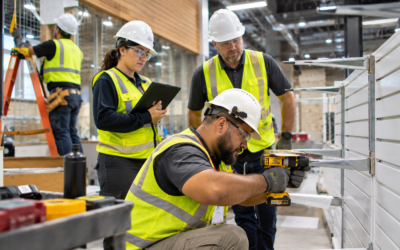

Accelerated retail construction projects leave little room for scheduling conflicts, incomplete work, or delays between trades.
When a retailer needs a renovation, build-out, or store improvement completed within a compressed timeframe, multiple contractors and specialty trades may need to work within the same facility over a relatively short period.
Electrical contractors, mechanical teams, plumbers, flooring installers, carpenters, fixture installers, and technology specialists all have responsibilities that must align with the overall construction schedule.
Each trade depends on certain activities being completed before its own work can begin. When those dependencies are not properly coordinated, crews may arrive before the site is ready, work areas may become congested, and completed installations may need to be removed or corrected.
These problems become more difficult to manage when several locations are progressing simultaneously.
Successful trade coordination requires more than putting subcontractors on a schedule. It involves understanding construction dependencies, establishing clear responsibilities, managing site readiness, and maintaining communication throughout execution.
For general contractors managing accelerated retail projects, the objective is to keep every trade aligned without compromising safety, workmanship, or project requirements.
Why Trade Coordination Matters in Accelerated Retail Construction
In a traditional construction schedule, certain activities may have more time between phases. Accelerated projects reduce that flexibility.
Multiple trades may need to work within overlapping timeframes, and delays in one activity can affect several others.
For example, a delayed electrical rough-in may prevent ceiling installation. Incomplete flooring may hold up fixture installation. Unverified power and data connections may delay checkout counter placement and equipment testing.
Common coordination challenges include:
-
Overlapping trade schedules
-
Incomplete preceding work
-
Limited access to work areas
-
Material and equipment delays
-
Conflicting installation requirements
-
Unclear subcontractor responsibilities
-
Insufficient field supervision
-
Delayed inspections and approvals
-
Unexpected existing building conditions
These issues can create a chain reaction across the project schedule.
Effective coordination helps identify these dependencies early and gives project managers greater control over how work progresses.
For additional context, see Planning for Compressed Construction Schedules.
1. Define Each Trade’s Scope and Responsibilities
Before construction begins, every participating trade should understand exactly what it is responsible for completing.
Unclear scope assignments can lead to duplicated work, missed activities, disputes, and delays.
A detailed scope review should identify:
-
Work included in each subcontractor’s assignment
-
Required materials and equipment
-
Installation specifications
-
Required labor and qualifications
-
Work area responsibilities
-
Schedule expectations
-
Inspection requirements
-
Documentation and closeout obligations
-
Coordination requirements with other trades
The project team should also identify interfaces between scopes.
For example, an electrical contractor may be responsible for providing power connections, while a fixture installer is responsible for placing and securing the retail fixture. Both parties need to understand the required connection locations, installation sequence, and verification process.
A responsibility matrix can help clarify which party performs, coordinates, inspects, and approves each activity.
The goal is to eliminate assumptions before they become field problems.
2. Identify Trade Dependencies Before Mobilization
Construction activities rarely happen independently.
Many installations depend on work completed by other trades. These relationships should be identified during preconstruction and reflected in the project schedule.
Typical retail construction dependencies include:
| Construction Activity | Required Coordination |
| Demolition | Utility identification and safe removal procedures |
| Framing | Structural requirements and rough-in coordination |
| Electrical rough-in | Equipment locations, fixture layouts, and power requirements |
| Mechanical installation | Ceiling layouts, ductwork, and equipment clearances |
| Plumbing rough-in | Fixture locations and approved connections |
| Inspections | Completion of applicable preceding work |
| Drywall and ceilings | Verification of concealed systems |
| Flooring | Completion of required below-floor and overhead work |
| Fixture installation | Finished surfaces and verified dimensions |
| Technology deployment | Power, cabling pathways, and equipment locations |
| Final testing | Completion and verification of connected systems |
These dependencies determine when a trade can realistically begin and when its work must be completed.
Project managers should identify critical handoffs and establish clear acceptance requirements before the next activity proceeds.
This reduces the risk of crews working over incomplete installations or creating rework.
For projects involving multiple technical disciplines, see Coordinating Electrical and Low-Voltage Work in Remodels.
3. Build a Schedule Around Trade Sequencing
An accelerated project schedule must account for the actual order in which work can be performed.
Simply assigning shorter durations to every activity does not guarantee faster completion.
The schedule should reflect:
-
Construction dependencies
-
Trade availability
-
Material delivery dates
-
Site access requirements
-
Required inspections
-
Work area limitations
-
Equipment availability
-
Project milestones
-
Critical-path activities
A typical retail construction sequence may include:
1. Site assessment and scope confirmation
2. Design coordination and approvals
3. Permitting and procurement
4. Site preparation and demolition
5. Framing and structural modifications
6. Electrical, mechanical, and plumbing rough-in
7. Required inspections
8. Drywall, ceilings, and interior finishes
9. Flooring and fixture installation
10. Technology and equipment deployment
11. Testing and commissioning
12. Punch list and final closeout
The actual sequence will vary based on the project scope and applicable requirements.
Some activities may overlap when the work can be performed safely and without interfering with other installations.
Project managers should identify which activities can proceed concurrently and which must wait for preceding work to be completed.
For a broader discussion of schedule acceleration, see Fast-Track Retail Construction Program.
4. Coordinate Work Areas to Prevent Trade Conflicts
One of the most common problems in accelerated construction is having too many people working in the same area without sufficient coordination.
Even when every subcontractor is following its assigned schedule, overlapping activities can create congestion and safety concerns.
For example, electrical, mechanical, and framing crews may all need access to the same ceiling space. Without a coordinated sequence, workers may interfere with one another or install systems in conflicting locations.
A work area coordination plan should establish:
-
Which trade has priority access
-
When each work area becomes available
-
Where materials and equipment can be staged
-
Which activities can overlap
-
Required clearance around equipment
-
Restricted work areas
-
Access and delivery routes
-
Daily work boundaries
For larger projects, dividing the facility into manageable work zones can improve coordination.
Each zone can have its own schedule, assigned trades, completion milestones, and inspection requirements.
This allows work to progress in one area while another is being prepared, provided that the separation is safe and the construction sequence supports it.
5. Confirm Material and Equipment Readiness Before Scheduling Crews
Trade coordination depends on more than labor availability.
A subcontractor may be ready to mobilize, but missing materials, incomplete equipment deliveries, or unavailable installation components can prevent meaningful progress.
Before confirming mobilization, project managers should verify:
-
Approved material specifications
-
Required quantities
-
Delivery dates
-
Equipment availability
-
Site receiving arrangements
-
Storage locations
-
Installation instructions
-
Required accessories and components
-
Compatibility with other project systems
Long-lead materials should be identified during preconstruction.
Custom fixtures, millwork, electrical equipment, lighting packages, and specialized components may require additional lead time.
Procurement tracking should continue throughout the project so that material availability remains aligned with the construction schedule.
For additional guidance, see Fixture and Millwork Installation Best Practices.
6. Establish Clear Communication Between Trades
Accelerated projects require timely communication.
A schedule can be well developed, but it becomes ineffective when subcontractors do not receive updated information or understand changes affecting their work.
Communication should address:
-
Daily work assignments
-
Upcoming trade transitions
-
Work area availability
-
Material delivery updates
-
Design revisions
-
Safety concerns
-
Inspection schedules
-
Outstanding deficiencies
-
Schedule changes
-
Required decisions and approvals
Project managers should establish a clear communication structure before mobilization.
Each trade should know who to contact for field coordination, scope clarification, schedule updates, and issue escalation.
Daily coordination meetings or brief field check-ins can help identify immediate constraints and confirm the next activities.
Important decisions should also be documented so that all affected parties are working from the same approved information.
7. Use Daily Coordination Meetings and Look-Ahead Schedules
A master construction schedule provides the overall project direction, but accelerated projects also benefit from shorter-term planning.
A two-week or three-week look-ahead schedule helps project managers identify upcoming trade requirements and potential conflicts before they affect field execution.
A practical look-ahead review should cover:
-
Activities planned for the upcoming weeks
-
Required preceding work
-
Assigned subcontractors
-
Labor availability
-
Material readiness
-
Equipment requirements
-
Inspection dates
-
Site access conditions
-
Potential constraints
-
Decisions needed from the project team
Daily coordination meetings can then focus on immediate field conditions.
For example, the project manager may confirm whether the electrical rough-in is complete, whether the required inspection has been passed, and whether the ceiling contractor can begin work in the designated area.
This creates a more controlled transition between trades.
8. Manage Changes Without Disrupting the Entire Schedule
Changes are common in retail construction, particularly when work involves existing buildings.
Field conditions may differ from the drawings. Equipment requirements may change. A client may request a revised fixture layout or additional electrical connections.
Even small revisions can affect several trades.
A formal change management process should evaluate:
-
Description of the requested change
-
Reason for the revision
-
Affected trades
-
Material and labor implications
-
Schedule impact
-
Cost implications
-
Required approvals
-
Updated drawings or specifications
Affected subcontractors should receive approved revisions before proceeding with work that may be impacted.
Project managers should also review downstream activities to determine whether the change affects other scheduled installations.
This helps prevent one modification from creating unnecessary rework across the project.
For related guidance, see Managing Non-Standard Retail Construction Projects.
9. Maintain Safety During Overlapping Construction Activities
Accelerated schedules may require multiple trades to work simultaneously.
However, overlapping work introduces additional safety considerations.
Workers may share access routes, operate equipment near one another, handle materials in confined spaces, or perform activities above and below other crews.
The project team should evaluate whether simultaneous activities can be performed safely before approving overlapping work.
Important controls may include:
-
Defined work zones
-
Controlled access
-
Appropriate barriers
-
Required personal protective equipment
-
Equipment movement coordination
-
Overhead work restrictions
-
Material staging controls
-
Electrical safety procedures
-
Housekeeping inspections
-
Daily hazard assessments
Certain activities should not overlap when doing so creates unacceptable exposure or conflicts with required safety procedures.
The project schedule should allow work to be resequenced when necessary to protect workers and others at the facility.
Safety requirements should never be reduced to recover lost schedule time.
For occupied retail environments, see Safety Considerations for Open-Store Construction.
10. Maintain Quality Control at Every Trade Handoff
Trade coordination is not complete when one subcontractor finishes its assigned work.
The completed installation must be verified before the next activity begins.
Without appropriate quality checks, deficiencies may remain hidden behind ceilings, walls, flooring, fixtures, or other finished components.
For example, electrical and mechanical installations should be inspected and verified at the appropriate stages before ceilings are closed.
Similarly, fixture dimensions and connection locations should be confirmed before final installation.
Quality control procedures should include:
-
Verification of completed work
-
Required inspections and approvals
-
Installation checks
-
Material verification
-
Progress documentation
-
Deficiency identification
-
Corrective action tracking
-
Acceptance before trade handoff
The project team should establish clear completion criteria for each major activity.
This helps prevent unfinished or defective work from being passed to the next trade.
11. Coordinate Specialty Trades and Technology Installations
Modern retail environments often involve specialized systems that must be integrated into the construction scope.
These may include:
-
Electrical distribution and lighting
-
Point-of-sale systems
-
Network infrastructure
-
Wireless access points
-
CCTV systems
-
Digital menu boards
-
Communications cabling
-
Specialized retail equipment
These installations require coordination between construction trades and technology specialists.
Power requirements, equipment dimensions, cable pathways, mounting locations, and connectivity requirements should be confirmed early.
For example, a POS installation may depend on the final checkout counter layout, available power, data connections, and network readiness.
If these requirements are not coordinated during preconstruction, installation may be delayed or require modifications to completed work.
Related resources include:
12. Use Centralized Project Oversight to Maintain Control
As the number of trades increases, so does the amount of information that must be coordinated.
A centralized project management structure helps maintain visibility across schedules, field activities, procurement, approvals, and outstanding issues.
Project managers should have access to consistent updates from subcontractors and field personnel.
Important information to track includes:
-
Trade assignments
-
Crew mobilization dates
-
Work completion status
-
Schedule milestones
-
Material availability
-
Inspection results
-
Open issues
-
Change requests
-
Safety observations
-
Quality deficiencies
-
Closeout requirements
Centralized oversight also helps identify recurring problems across multiple projects.
For example, if several locations experience delays involving the same trade or installation requirement, the program team can investigate the underlying issue and adjust future planning.
For more information, see How Centralized Oversight Improves Consistency.
Common Trade Coordination Problems in Accelerated Retail Projects
Even well-planned construction programs can encounter coordination challenges.
The key is identifying potential problems early and establishing a clear response process.
Crews Arrive Before the Work Area Is Ready
Subcontractors may arrive as scheduled but find that preceding activities remain incomplete.
How to address it: Use documented readiness checks before confirming mobilization.
Multiple Trades Compete for the Same Work Area
Different contractors may need access to the same ceiling, corridor, or installation zone.
How to address it: Establish work area assignments, trade priorities, and coordinated access schedules.
Materials Are Not Available When Needed
A crew may be ready to install equipment or fixtures, but required components have not arrived.
How to address it: Align procurement tracking with the master schedule and look-ahead planning.
Scope Responsibilities Overlap
Two subcontractors may assume that the other is responsible for a specific installation or connection.
How to address it: Define scope boundaries and trade interfaces before mobilization.
Design Changes Affect Completed Work
Late revisions may require previously installed components to be modified or removed.
How to address it: Use formal change management and communicate approved revisions to every affected trade.
Inadequate Field Supervision
Without sufficient oversight, scheduling conflicts and installation deficiencies may go unnoticed.
How to address it: Establish clear supervision responsibilities and regular field reporting.
Schedule Recovery Creates Safety Risks
Teams may attempt to recover lost time by overlapping activities that should not occur simultaneously.
How to address it: Evaluate safety and technical dependencies before changing the construction sequence.
How to Measure Trade Coordination Performance
Trade coordination should be evaluated through measurable project indicators.
These help project managers understand whether subcontractors are working efficiently and whether the construction sequence is supporting the overall schedule.
| Performance Indicator | What It Measures |
| Trade schedule adherence | Completion of assigned activities against planned dates |
| Work area readiness | Percentage of scheduled activities beginning with required conditions in place |
| Trade handoff completion | Successful transition between consecutive construction activities |
| Crew utilization | Productive time compared with scheduled availability |
| Material readiness | Availability of required materials before installation |
| Coordination issue frequency | Number of conflicts affecting field execution |
| Rework frequency | Additional work caused by incomplete or incorrect installations |
| First-pass quality | Work accepted without corrective action |
| Safety performance | Compliance with project safety requirements |
| Schedule variance | Difference between planned and actual milestone completion |
| Closeout completion | Timely completion of deficiencies and required documentation |
Tracking these indicators can help identify bottlenecks and improve coordination on future projects.
Trade Coordination Across Multi-Location Retail Programs
Coordinating trades at one location can be challenging. Managing the same activities across several locations adds another level of complexity.
A nationwide rollout may require similar construction scopes to be completed by different crews in multiple markets.
Each location may have different site conditions, permitting requirements, labor availability, and material delivery constraints.
A coordinated multi-site strategy should establish:
-
Standardized scopes of work
-
Consistent installation specifications
-
Regional trade partner assignments
-
Location-specific construction schedules
-
Centralized procurement tracking
-
Standardized inspection procedures
-
Clear reporting requirements
-
Consistent quality expectations
-
Centralized issue escalation
-
Program-wide schedule visibility
Standardization helps establish consistent expectations, while site-specific planning accounts for local conditions.
For additional guidance, see:
What to Look for in a General Contractor for Accelerated Retail Projects
Selecting the right general contractor is important when a project requires multiple trades to work within a compressed schedule.
Retailers should evaluate whether the contractor has the experience and management structure to coordinate the complete construction scope.
Important qualifications include:
Preconstruction coordination: Can the contractor identify trade dependencies, scope gaps, and site constraints before mobilization?
Trade partner network: Does the contractor have access to qualified subcontractors and specialty trades?
Scheduling capabilities: Can the team develop realistic construction sequences and monitor critical milestones?
Procurement management: Does the contractor track material availability and delivery requirements?
Field supervision: Are qualified personnel responsible for coordinating daily activities and trade handoffs?
Safety management: Can the contractor maintain appropriate safety controls when multiple crews are working simultaneously?
Quality control: Are inspections and acceptance criteria established throughout construction?
Centralized oversight: Can the contractor maintain visibility across multiple trades and locations?
The right construction partner should be able to demonstrate how these capabilities work together to support accelerated execution.
For more information, see Benefits of Working With One Nationwide General Contractor.
How Prime Retail Services Supports Accelerated Retail Construction
Prime Retail Services is a nationwide commercial general contractor supporting construction, renovation, and multi-location programs across retail and other commercial environments.
Accelerated projects require coordinated planning, qualified trade partners, procurement readiness, and consistent field oversight.
Our approach emphasizes aligning construction activities and project requirements to support organized execution across each location.
Our capabilities include:
-
Remodels and Renovations: Coordinated construction activities within existing commercial facilities.
-
Build-Outs and Store Refreshes: Execution of commercial improvements and interior modifications.
-
Special Project Rollouts: Coordinated execution for time-sensitive construction requirements.
-
Multi-Site FF&E Programs: Management of fixture, furniture, and equipment installations across multiple locations.
-
Electrical Coordination: Additional project capabilities through Prime Power Solutions.
-
Technology Deployment: Technology installation and infrastructure support through Prime-Net.
Through our proprietary 3P Process, Perfect, Project, Process, we emphasize execution quality, project coordination, and repeatable procedures that support consistent project delivery.
With general contracting licenses in 49 states, excluding Hawaii, Prime Retail Services supports commercial construction requirements across a broad geographic footprint.
Our focus is to help clients coordinate construction activities, manage project requirements, and maintain visibility throughout execution.
Frequently Asked Questions
What is trade coordination in construction?
Trade coordination is the process of organizing different subcontractors and construction disciplines so their work is properly sequenced, their responsibilities are clear, and their activities do not create unnecessary conflicts.
Why is trade coordination important in accelerated retail projects?
Compressed schedules leave less time to recover from delays. Effective coordination helps prevent scheduling conflicts, incomplete handoffs, material-related delays, and rework.
Which trades are commonly involved in retail construction?
Depending on the project, trades may include demolition, framing, electrical, mechanical, plumbing, drywall, flooring, painting, fixture installation, millwork, and low-voltage technology specialists.
How do general contractors prevent trade scheduling conflicts?
They use coordinated schedules, look-ahead planning, work area assignments, daily communication, and field supervision to align subcontractor activities.
What is a trade handoff?
A trade handoff occurs when one contractor completes an activity or work area and the next contractor is authorized to proceed. The handoff should include verification that required work is complete and the area is ready.
Can multiple trades work simultaneously?
Yes, when activities are technically compatible and can be performed safely. Work areas, access routes, and construction dependencies must be coordinated before overlapping activities are approved.
How does procurement affect trade coordination?
Subcontractors need materials and equipment to perform their assigned work. Procurement delays can prevent crews from starting or completing scheduled activities.
What is a look-ahead construction schedule?
A look-ahead schedule is a short-term planning tool, often covering two or three weeks, that identifies upcoming activities, labor requirements, materials, dependencies, and potential constraints.
How can retailers improve coordination across multiple locations?
Retailers can use standardized scopes, consistent specifications, regional trade partner networks, centralized scheduling, and program-wide reporting to maintain alignment across locations.
Does accelerated construction mean safety procedures can be shortened?
No. Schedule acceleration should come from better planning, coordination, and reduced waiting time. Required safety procedures, inspections, and technical standards must remain in place.
Final Thoughts
Trade coordination is one of the most important factors in successfully executing accelerated retail construction projects.
When multiple contractors and specialty trades must work within compressed schedules, every activity must be connected to the broader construction plan.
Clear responsibilities, realistic sequencing, material readiness, defined work areas, and consistent communication help reduce avoidable conflicts and maintain project momentum.
The objective is not simply to get more crews onto the jobsite. It is to ensure that each trade can complete its work at the right time, under the right conditions, and according to the required standards.
With disciplined coordination and centralized project oversight, accelerated retail projects can move forward with greater control over schedules, quality, and safety.
Planning an accelerated retail construction project?
Contact Prime Retail Services at info@primeretailservices.com to discuss your next commercial construction project.