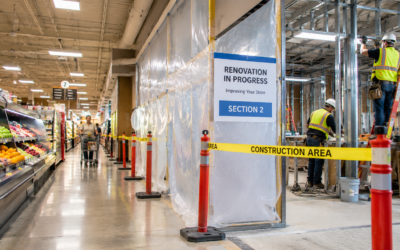
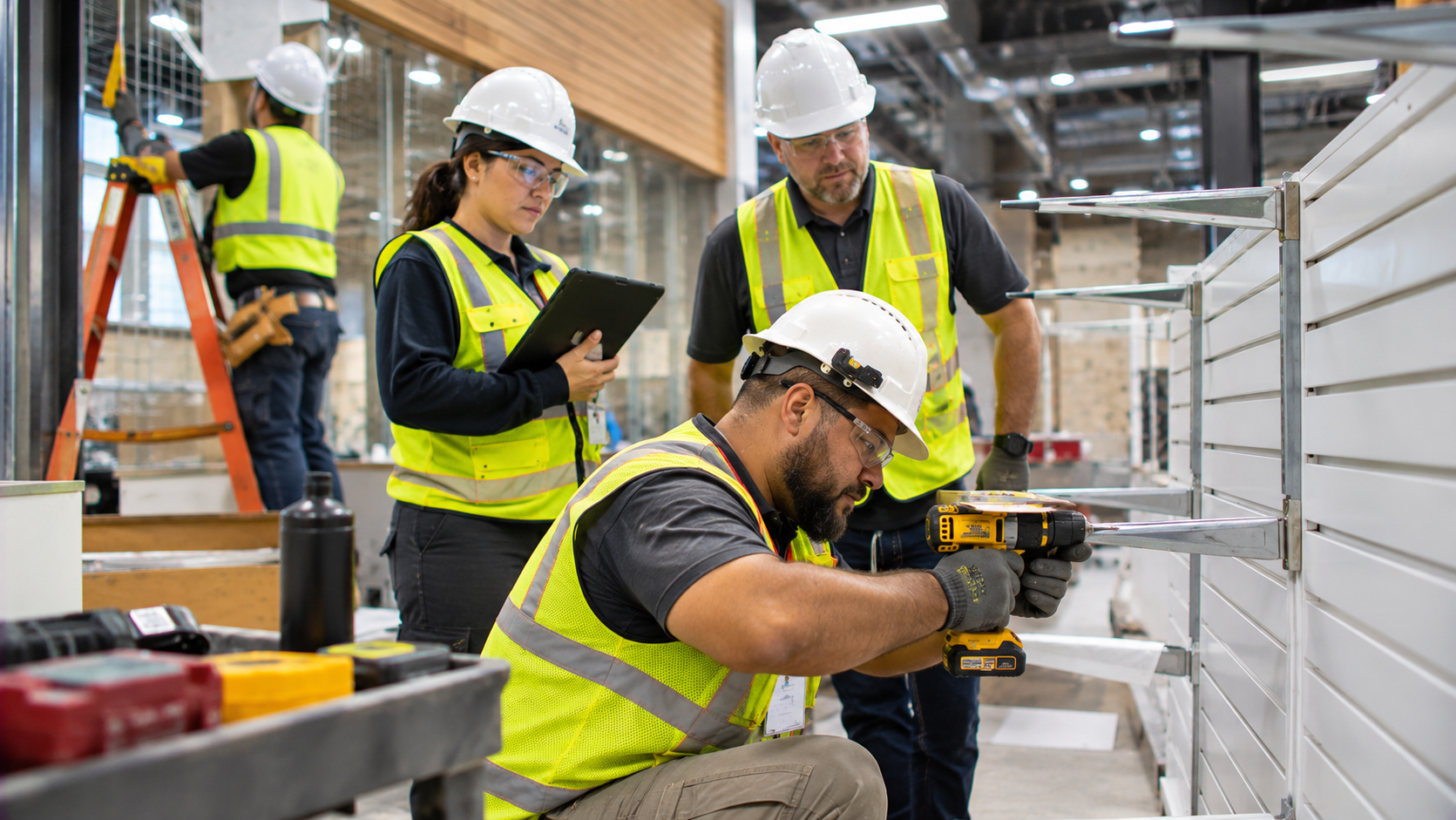
Commercial construction and retail installation projects involve multiple moving parts. General contractors must coordinate schedules, manage materials, oversee field activities, and ensure that every installation meets the required project standards.
When installation work is distributed across several independent subcontractors, maintaining consistent oversight can become more challenging. Different crews may follow different procedures, have varying levels of familiarity with project requirements, and operate under separate scheduling and communication structures.
These differences can introduce risks that affect project timelines, installation quality, accountability, and overall execution.
In-house installation crews offer another approach. By maintaining a directly coordinated workforce for selected installation activities, a general contractor can establish more consistent work procedures, improve communication, and maintain closer oversight of field execution.
This does not eliminate every construction risk. However, when properly managed, an in-house workforce can reduce certain coordination gaps and provide greater control over critical installation activities.
For retailers and commercial organizations managing renovations, fixture installations, technology deployments, and multi-location programs, this level of control can make a meaningful difference.
What Are In-House Installation Crews?
In-house installation crews are workers employed or directly managed by a contractor to perform designated installation activities rather than relying entirely on independent subcontractors.
The specific responsibilities of these crews depend on the contractor’s business model, workforce capabilities, licensing, and project requirements.
In commercial construction and retail environments, in-house installation teams may support activities such as:
-
Fixture and equipment installation
-
Furniture and millwork installation
-
Point-of-sale equipment deployment
-
Technology and low-voltage installations, where appropriately qualified
-
Store refresh and renovation activities
-
Specialty installation scopes
-
Punch-list and corrective work
The general contractor maintains greater direct involvement in workforce assignments, training, scheduling, supervision, and performance expectations.
In-house crews may work alongside subcontractors and specialty trade partners. The objective is not necessarily to eliminate subcontracting, but to determine which activities benefit from direct workforce control and which require specialized external resources.
Why Installation Workforce Structure Matters
The way installation work is organized can influence how effectively a project is managed.
When multiple independent contractors are responsible for different portions of an installation, the general contractor must coordinate their schedules, responsibilities, communication, and quality expectations.
This arrangement can work effectively when responsibilities are clearly defined and each contractor performs as expected.
However, additional coordination may be required when schedules change, site conditions differ from the original plan, or one contractor’s work depends on another’s completion.
A directly coordinated installation workforce can help simplify certain parts of this process.
Potential benefits include:
-
More direct control over crew assignments
-
Consistent installation procedures
-
Clearer performance expectations
-
Faster communication with field personnel
-
Better visibility into workforce availability
-
More consistent quality oversight
-
Greater flexibility when adjusting installation schedules
These advantages can help reduce execution risks, particularly in projects involving repeated installations or multiple locations.
1. Improve Accountability at the Field Level
One of the primary advantages of in-house installation crews is clearer workforce accountability.
When workers are directly managed by the contractor, supervisors can establish consistent expectations for attendance, workmanship, safety, productivity, and documentation.
This creates a more direct relationship between project management and field execution.
For example, if a fixture installation does not meet the approved layout, the supervisor can communicate the correction directly to the assigned crew and verify that the issue has been addressed.
With multiple independent contractors, the same issue may require additional communication between the general contractor, subcontractor management, and the individual installation team.
A directly coordinated workforce can simplify this communication chain.
Accountability should still be supported by documented procedures, defined responsibilities, and measurable performance standards.
Direct employment or management alone does not guarantee quality. The workforce must also receive appropriate training, supervision, and performance feedback.
2. Maintain More Consistent Installation Standards
Consistency becomes increasingly important when the same installation scope must be completed across several locations.
Different crews may interpret drawings, installation instructions, and quality expectations differently.
This can result in variations in fixture alignment, equipment placement, workmanship, and final appearance.
In-house crews can help reduce these variations by following common installation procedures established by the contractor.
Standardized procedures may include:
-
Approved installation instructions
-
Required tools and equipment
-
Material handling procedures
-
Layout and measurement requirements
-
Mounting and fastening standards
-
Quality inspection checklists
-
Photographic documentation
-
Final verification procedures
Supervisors can reinforce these standards through regular field inspections and performance reviews.
For multi-location programs, the same installation expectations can be communicated across crews working in different markets.
This helps create a more repeatable execution process while allowing adjustments for individual site conditions.
Related article: Standardization vs. Flexibility in Multi-Site Programs.
3. Reduce Scheduling and Mobilization Risks
Installation schedules often depend on workforce availability.
When projects rely entirely on independent subcontractors, the general contractor may have limited control over their competing commitments and crew assignments.
A subcontractor may need to balance several projects, potentially affecting availability when schedules change.
An in-house workforce can provide greater visibility into crew capacity and assignment priorities.
Project managers can coordinate workforce deployment based on:
-
Project deadlines
-
Site readiness
-
Installation scope
-
Crew qualifications
-
Geographic coverage
-
Material availability
-
Required completion milestones
This can make it easier to plan installation activities and adjust assignments when project conditions change.
For example, if one location becomes unavailable because of a site condition, management may be able to redirect available crews to another ready location, subject to travel, qualifications, and scheduling constraints.
This flexibility can help reduce idle labor and unnecessary remobilization.
Related articles:
4. Strengthen Communication Between Project Management and Installers
Communication gaps can create unnecessary risk during installation projects.
Field crews need accurate information about project scope, site conditions, installation details, schedule changes, and client requirements.
When communication passes through several independent organizations, important information may take longer to reach the people performing the work.
A directly coordinated workforce can create a more straightforward communication structure.
Project managers and field supervisors can communicate updates through established internal channels.
This can help with:
-
Clarifying installation instructions
-
Communicating schedule changes
-
Reporting site conditions
-
Identifying missing materials
-
Escalating installation conflicts
-
Coordinating corrective work
-
Confirming completion requirements
Direct communication also helps management receive field feedback more quickly.
Installers often identify practical issues that are not immediately apparent during preconstruction. A clear reporting process allows these observations to reach the appropriate project personnel.
Related article: Communication Strategies for Multi-Location Projects.
5. Improve Quality Oversight and Deficiency Resolution
Installation quality depends on more than the skills of individual workers.
It also depends on how work is inspected, how deficiencies are reported, and how corrective actions are managed.
In-house installation crews can make quality oversight more direct because supervisors work within an established management structure.
Quality procedures can be incorporated into daily field activities rather than relying exclusively on separate subcontractor reporting processes.
A practical quality-control approach may include:
1. Reviewing approved installation requirements.
2. Confirming site readiness before work begins.
3. Verifying materials and equipment.
4. Monitoring installation methods.
5. Inspecting completed work.
6. Documenting deficiencies.
7. Assigning corrective actions.
8. Verifying completed corrections.
This approach helps identify problems before they affect subsequent construction activities.
For example, a supervisor may identify an improperly aligned fixture before additional equipment is installed around it.
Correcting the issue at that stage is generally more manageable than discovering it during final inspection.
In-house crews do not replace independent inspections, required code inspections, or specialized quality verification. They provide another layer of direct field oversight.
6. Reduce the Risk of Inconsistent Training and Procedures
Installation crews need to understand the equipment, materials, tools, and procedures associated with their assigned work.
When a contractor frequently engages different external crews, the level of familiarity with its preferred procedures may vary.
An established in-house workforce can provide greater consistency in training and operational expectations.
Training programs may cover:
-
Installation procedures
-
Equipment handling
-
Material protection
-
Workplace safety
-
Quality requirements
-
Documentation standards
-
Client-specific expectations
-
Site access procedures
-
Communication and reporting
Training should be appropriate to each worker’s assigned responsibilities.
For regulated work, personnel must also meet applicable licensing, certification, and qualification requirements.
A consistent training program helps reduce misunderstandings and supports more predictable field execution.
7. Improve Control Over Material Handling and Equipment
Materials and equipment can represent a significant portion of installation project costs.
Poor handling, incorrect storage, missing components, and damaged materials can create delays and additional expenses.
A directly coordinated installation workforce can help establish more consistent material handling practices.
Procedures may address:
-
Receiving and verifying deliveries
-
Inspecting materials for damage
-
Organizing equipment and components
-
Protecting finished materials
-
Managing tools and installation equipment
-
Tracking missing or damaged items
-
Coordinating material movement
-
Maintaining clean work areas
For example, fixture and millwork installations may involve finished surfaces that can be scratched or damaged during transportation and positioning.
Consistent handling procedures can help reduce preventable damage.
The project team should also coordinate material availability with the installation schedule to avoid sending crews to locations where required components have not arrived.
Related article: Fixture and Millwork Installation Best Practices.
8. Improve Flexibility When Site Conditions Change
Commercial construction projects rarely proceed exactly as originally planned.
Existing buildings may contain unexpected conditions, equipment deliveries may change, and client requirements may evolve.
These situations can require adjustments to installation schedules and workforce assignments.
An in-house workforce may provide greater flexibility when management needs to redirect crews or coordinate corrective work.
For example, if one installation area is not ready, project management may be able to assign the crew to another completed or accessible area.
Similarly, a directly coordinated team may be easier to schedule for return visits when adjustments or punch-list work are necessary.
However, flexibility depends on crew availability, geographic coverage, qualifications, travel requirements, and the contractor’s workforce capacity.
It should be supported by realistic scheduling rather than assumed availability.
Related article: Managing Non-Standard Retail Construction Projects.
9. Strengthen Safety Oversight and Worksite Accountability
Installation activities can involve lifting, material handling, power tools, elevated work, electrical equipment, and other potential hazards.
Maintaining consistent safety expectations is essential.
An in-house workforce allows a contractor to establish internal safety procedures and reinforce them through regular training and supervision.
Safety oversight may include:
-
Jobsite orientation
-
Personal protective equipment requirements
-
Tool and equipment inspections
-
Material handling procedures
-
Work area housekeeping
-
Hazard identification
-
Incident reporting
-
Emergency procedures
-
Required task-specific training
Supervisors should also verify that work practices remain appropriate as site conditions change.
Direct workforce management can improve the consistency of safety communication, but it does not remove the contractor’s legal responsibilities or eliminate the need to coordinate with other employers and subcontractors on shared jobsites.
Applicable safety requirements must be followed by everyone performing work at the location.
10. Improve Documentation and Installation Visibility
Project documentation provides a record of what was installed, where work was completed, and whether required quality checks were performed.
When field personnel follow consistent reporting procedures, project management can maintain better visibility into installation progress.
Documentation may include:
-
Daily installation reports
-
Crew assignments
-
Completed work quantities
-
Photographic records
-
Material usage
-
Site condition reports
-
Deficiency lists
-
Corrective action records
-
Quality inspection results
-
Final completion documentation
This information helps project managers identify locations that are progressing as planned and those that require additional attention.
It also supports communication with clients and provides a useful record for future maintenance or project reference.
For multi-location programs, standardized reporting makes it easier to compare progress and identify recurring installation issues.
Related article: How Centralized Oversight Improves Consistency.
11. Use In-House Crews Alongside Qualified Specialty Contractors
In-house installation crews do not need to perform every construction activity.
Many commercial projects require specialized expertise, licensed trades, engineering support, or manufacturer-authorized services.
The most effective workforce strategy identifies which activities benefit from direct workforce management and which should be assigned to qualified specialty contractors.
For example, a general contractor may use in-house personnel for selected fixture or equipment installation activities while coordinating licensed electrical, plumbing, mechanical, or fire protection contractors for regulated work.
This approach allows the contractor to maintain direct control over appropriate installation scopes without exceeding the qualifications or capabilities of its workforce.
Responsibilities should be clearly defined before mobilization.
The project team should also coordinate interfaces between in-house crews and specialty contractors to prevent gaps in scope or conflicting installation activities.
Related articles:
12. Apply Workforce Standards Across Multi-Location Programs
For nationwide retail programs, installation consistency becomes more challenging as the number of locations increases.
Different markets may involve different site conditions, access requirements, schedules, and available resources.
An established in-house workforce can support a more consistent operating model when the contractor has sufficient geographic coverage and qualified personnel.
A scalable workforce strategy may include:
-
Standard crew responsibilities
-
Defined installation procedures
-
Consistent training requirements
-
Centralized scheduling
-
Standardized reporting
-
Quality inspection criteria
-
Clear escalation procedures
-
Documented closeout requirements
These standards help establish common expectations across locations.
However, each project must still account for local conditions, applicable licensing requirements, and the specific qualifications needed for the assigned work.
For additional context, see Managing Large-Scale Retail Programs Nationwide.
Common Risks That In-House Installation Crews Can Help Reduce
An in-house workforce can help address several recurring installation risks when supported by effective management and sufficient resources.
Unclear Field Accountability
When responsibilities are spread across several organizations, it may be difficult to determine who owns a specific installation issue.
Better approach: Establish clear crew responsibilities, supervision, and escalation procedures.
Inconsistent Installation Procedures
Different crews may interpret installation instructions and quality requirements differently.
Better approach: Use standardized procedures, training, and inspection checklists.
Delayed Field Communication
Important information may take longer to reach the people performing the work.
Better approach: Maintain direct communication channels between project management, supervisors, and installers.
Limited Workforce Visibility
Project managers may have difficulty confirming subcontractor availability and competing commitments.
Better approach: Maintain centralized workforce scheduling and realistic capacity planning.
Repeated Installation Deficiencies
Workmanship problems may not be identified until final inspection.
Better approach: Incorporate routine quality checks and documented corrective actions into daily field operations.
Poor Material Handling
Equipment and materials may be damaged or misplaced during installation.
Better approach: Establish consistent receiving, storage, handling, and protection procedures.
Unnecessary Remobilization
Incomplete work or coordination gaps may require additional trips to a project location.
Better approach: Verify site readiness, material availability, and installation requirements before dispatching crews.
When In-House Installation Crews May Not Be the Best Fit
Although direct workforce management offers potential advantages, it is not automatically the right approach for every construction activity.
General contractors should evaluate the scope, qualifications, geography, schedule, and available resources before deciding how installation work should be performed.
Subcontractors or specialty providers may be more appropriate when a project requires:
-
Specialized technical expertise
-
Trade-specific licensing
-
Manufacturer-authorized installation
-
Specialized testing or commissioning
-
Equipment that requires dedicated installation personnel
-
Temporary workforce capacity beyond the contractor’s available resources
-
Local expertise or jurisdiction-specific qualifications
An effective workforce strategy is not about performing everything internally.
It is about assigning each scope to the most appropriate qualified resource while maintaining clear accountability and coordinated project oversight.
How to Measure the Performance of In-House Installation Crews
A contractor should evaluate its installation workforce using measurable performance indicators.
These measurements help determine whether direct workforce management is improving project execution and reducing preventable risks.
| Performance Indicator | What It Measures |
| First-pass quality rate | Percentage of installations accepted without corrective work |
| Installation schedule adherence | Performance against planned completion dates |
| Rework frequency | Number of installations requiring corrective work |
| Crew productivity | Completed installation quantities relative to labor hours |
| Site readiness rate | Percentage of locations ready when crews arrive |
| Remobilization frequency | Additional trips required to complete assigned work |
| Material damage rate | Frequency of damaged or unusable installation materials |
| Safety observations | Identification and resolution of jobsite hazards |
| Deficiency resolution time | Time required to correct installation issues |
| Documentation completeness | Completion of required reports, photographs, and closeout records |
These indicators should be reviewed together rather than individually.
For example, high installation productivity is not necessarily a positive result if rework and deficiency rates are also increasing.
Similarly, reducing labor hours should not come at the expense of safety or workmanship.
The objective is to maintain a balanced view of productivity, quality, safety, and schedule performance.
What to Look for in a General Contractor With In-House Installation Crews
Retailers and commercial organizations should evaluate more than whether a contractor maintains its own installation workforce.
They should understand how that workforce is managed and how it contributes to overall project execution.
Important considerations include:
Workforce qualifications: Are installation personnel appropriately trained and qualified for their assigned responsibilities?
Direct supervision: Does the contractor maintain clear field supervision and accountability?
Installation standards: Are consistent procedures and quality expectations established?
Scheduling capability: Can the contractor coordinate crew assignments across multiple locations?
Geographic coverage: Does the contractor have the resources to support the required project locations?
Safety management: Are safety procedures reinforced through training and field oversight?
Specialty trade coordination: Can the contractor coordinate in-house crews with licensed subcontractors and specialty providers?
Quality assurance: Are installation inspections and corrective actions documented?
Reporting: Does management maintain visibility into field progress and completion?
Scalability: Can the contractor increase workforce capacity when project volume grows?
An effective in-house installation model should provide more than direct access to labor. It should be supported by the systems, supervision, and project management capabilities needed to turn that labor into consistent results.
How Prime Retail Services Supports Controlled Installation Execution
Prime Retail Services is a nationwide commercial general contractor supporting construction, renovation, and multi-location programs across retail and other commercial environments.
Successful installation programs require coordination between project management, field personnel, specialty contractors, suppliers, and client representatives.
Our approach emphasizes structured project management, coordinated execution, and consistent communication to support quality and accountability across commercial construction programs.
Our capabilities include:
-
Remodels and Renovations: Coordinated construction activities within existing commercial facilities.
-
Build-Outs and Store Refreshes: Execution of commercial improvements and interior modifications.
-
Special Project Rollouts: Coordinated execution for time-sensitive construction requirements.
-
Multi-Site FF&E Programs: Management of fixture, furniture, and equipment installations across multiple locations.
-
Electrical Coordination: Additional project capabilities through Prime Power Solutions.
-
Technology Deployment: Technology installation and infrastructure support through Prime-Net.
Through our proprietary 3P Process, Perfect, Project, Process, we emphasize execution quality, project coordination, and repeatable procedures that support consistent project delivery.
With general contracting licenses in 49 states, excluding Hawaii, Prime Retail Services supports commercial construction requirements across a broad geographic footprint.
Our focus is to help clients coordinate qualified resources, maintain project visibility, and manage installation activities across commercial construction programs.
Frequently Asked Questions
What are in-house installation crews?
In-house installation crews are workers employed or directly managed by a contractor to perform designated installation activities. Their responsibilities depend on the contractor’s capabilities, workforce qualifications, and project scope.
How do in-house crews reduce construction risk?
They can improve workforce accountability, communication, scheduling visibility, consistency, and direct quality oversight. These benefits depend on effective supervision, training, and resource planning.
Are in-house installation crews better than subcontractors?
Not necessarily. Each approach has advantages. In-house crews can provide greater direct control over selected activities, while subcontractors may offer specialized expertise, licensing, equipment, or additional workforce capacity.
Can in-house crews support nationwide retail programs?
Yes, when the contractor has sufficient geographic coverage, qualified personnel, workforce capacity, and centralized scheduling capabilities.
Do in-house installation crews eliminate the need for specialty contractors?
No. Many projects still require licensed trades, specialized technical expertise, manufacturer-authorized installers, or other qualified providers.
How do in-house crews improve installation quality?
They can follow consistent procedures, receive standardized training, work under established supervision, and participate in routine quality inspections.
Can in-house crews help reduce project delays?
They may improve workforce scheduling and communication, particularly when installation assignments and site readiness are centrally coordinated. Actual results depend on crew availability, travel, materials, and project conditions.
What should contractors consider before building an in-house installation team?
They should evaluate installation demand, workforce availability, training requirements, geographic coverage, supervision, equipment needs, labor costs, and applicable licensing or qualification requirements.
How should in-house installation performance be measured?
Useful indicators include first-pass quality, schedule adherence, productivity, rework frequency, remobilization, safety observations, and documentation completeness.
Does having in-house crews guarantee better project outcomes?
No. Direct workforce management can improve control, but successful execution still depends on planning, qualifications, supervision, materials, communication, and quality procedures.
Final Thoughts
Reducing installation risk requires more than assigning workers to complete a project scope.
It requires clear accountability, qualified personnel, consistent procedures, effective supervision, and reliable communication between project management and field teams.
In-house installation crews can strengthen these areas by giving contractors greater direct involvement in workforce assignments, training, scheduling, and quality oversight.
However, the benefits depend on using the right workforce model for each activity. Specialized and regulated scopes still require appropriately qualified contractors and providers.
The most effective approach combines direct workforce control where it adds value with coordinated specialty resources where additional expertise is necessary.
Ultimately, a well-managed installation workforce helps general contractors improve execution visibility, address issues more quickly, and maintain consistent expectations across commercial construction programs.
Looking for a construction partner that can coordinate installation resources across multiple locations?
Contact Prime Retail Services at info@primeretailservices.com to discuss your next commercial construction project.