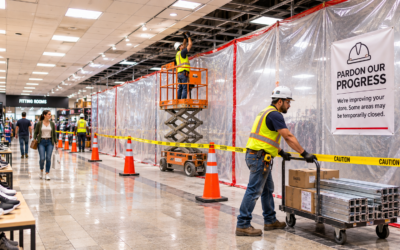

When a commercial facility needs urgent construction, renovation, or corrective work, the ability to mobilize quickly can make a significant difference. Delays can affect store operations, scheduled openings, equipment installations, and other critical business milestones.
For retailers managing multiple locations, urgent projects often require rapid site assessments, qualified trade partners, material procurement, and coordinated field execution within a compressed timeframe.
However, rapid mobilization involves more than dispatching a crew as soon as possible. Without adequate preparation, an accelerated start can lead to incomplete scopes, material shortages, rework, safety concerns, and unexpected costs.
Successful rapid mobilization combines speed with disciplined project management. By confirming requirements, aligning resources, and resolving critical dependencies early, organizations can accelerate execution without losing control over quality, safety, or cost.
What Is Rapid Mobilization in Commercial Construction?
Rapid mobilization is the accelerated preparation and deployment of the personnel, materials, equipment, trade partners, and management resources needed to begin a construction project.
The process typically includes:
- Confirming the project scope, objectives, and deadline.
- Assessing site conditions and access requirements.
- Assigning qualified personnel and trade partners.
- Coordinating materials, equipment, and deliveries.
- Confirming applicable permits, approvals, and safety requirements.
- Establishing the work sequence, communication procedures, and reporting expectations.
In time-sensitive projects, these activities often need to proceed in parallel rather than sequentially. For example, while a project manager confirms the scope, the team may also be checking material availability, coordinating site access, and identifying qualified trade partners.
The goal is to eliminate avoidable waiting while ensuring the project is ready for productive and compliant execution.
What Qualifies as a Time-Sensitive Special Project?
A special project often falls outside a routine maintenance schedule or established rollout program. It may involve unusual site conditions, an urgent operational need, a fixed deadline, or specialized construction requirements.
Examples include:
- Urgent retail renovations: Completing corrective work before a reopening or operational milestone.
- Store opening deadlines: Finishing targeted construction or installation work within a fixed transition window.
- Facility repairs: Addressing construction-related issues that affect commercial operations.
- Last-minute project additions: Completing newly identified work before an inspection or scheduled launch.
- Electrical and infrastructure upgrades: Coordinating work within an approved outage or limited access window.
- Special installations: Deploying fixtures, equipment, or other commercial components on an accelerated schedule.
- Multi-location corrective programs: Addressing similar issues across several facilities within a coordinated timeframe.
Each project has different constraints. Some can proceed quickly once the scope and access are confirmed. Others require engineering review, permits, specialized equipment, or additional technical coordination.
Understanding these requirements early helps teams establish a realistic mobilization plan.
For more information, see our guide to what qualifies as a retail special project.
Why Rapid Mobilization Matters
1. Minimize Operational Disruption
Construction in active retail environments must account for customers, employees, operating hours, and restricted work areas.
Rapid mobilization helps teams coordinate access, staffing, deliveries, and construction sequencing around these requirements. When planned effectively, it can reduce disruption and help return affected areas to service sooner.
2. Protect Critical Business Deadlines
Store openings, inspections, equipment installations, and scheduled refreshes often depend on specific completion dates.
A delayed start reduces the time available for construction, testing, corrections, and closeout. Identifying critical activities and dependencies early helps teams prioritize resources and protect important milestones.
3. Prevent Resource Bottlenecks
A project cannot progress efficiently if materials are unavailable, site access is unconfirmed, or required trade partners are not ready.
Early coordination helps verify that the people, equipment, materials, and approvals needed for upcoming activities will be available when required.
4. Improve Responsiveness Across Multiple Locations
For retailers operating across several markets, urgent requests can compete for the same resources and management attention.
A coordinated approach helps organizations prioritize projects, assign resources, and maintain visibility into progress. Nationwide construction program management provides a framework for coordinating resources, reporting, and execution across locations.
5. Maintain Control Under Compressed Schedules
A tight deadline does not remove the need for scope verification, safety planning, quality control, or documentation.
A structured mobilization process establishes responsibilities, approval requirements, and reporting expectations before field execution begins. This reduces avoidable mistakes and helps teams respond to issues before they become larger problems.
The Rapid Mobilization Process: From Request to Field Execution
An effective process moves the project from initial request to productive field execution through eight coordinated steps.
Step 1: Confirm the Scope and Deadline
Establish what needs to be completed, why it is urgent, and when the work must be finished.
The initial request should identify:
- Project location and primary contact.
- Required work and intended outcome.
- Requested start date and completion deadline.
- Site conditions and operating restrictions.
- Required trades, equipment, and specialty capabilities.
- Available drawings, photographs, and specifications.
- Known permitting, inspection, and approval requirements.
Determine whether the requested deadline is feasible based on the information available. If critical details are missing, identify what must be confirmed before committing to a schedule.
Step 2: Assess the Site and Validate the Scope
A site assessment helps confirm the work required and identify conditions that could affect execution.
Depending on the project, the assessment may cover existing building systems, access and staging, utility requirements, material delivery, trade coordination, safety considerations, and conflicts with ongoing operations.
Remote assessments can accelerate initial planning, but an on-site inspection may still be necessary when measurements, concealed conditions, or physical safety requirements need verification.
Document findings and identify any additional work or technical review required before proceeding.
Step 3: Build a Critical-Path Schedule
Identify the activities that determine the project’s completion date and the dependencies that must be resolved before each can proceed.
A practical schedule should include:
- Key activities and milestones.
- Assigned personnel and responsibilities.
- Material and equipment delivery dates.
- Required approvals and inspections.
- Client coordination milestones.
- Potential delays and contingency measures.
- Final verification and closeout activities.
Where appropriate, independent activities can proceed in parallel. However, overlapping work must not introduce unsafe conditions or bypass required approvals.
A structured fast-track retail construction program can help coordinate overlapping activities and maintain visibility into compressed schedules.
Step 4: Assign Qualified Personnel and Trade Partners
Identify the personnel and trade partners required for the complete scope, not just the initial site visit.
Confirm their availability, qualifications, geographic coverage, and ability to meet the project’s requirements. Depending on the work, the team may include a project manager, field supervisor, specialty trades, installation technicians, and procurement or logistics support.
An early start provides little benefit if a critical trade cannot arrive when the next phase requires it.
Step 5: Confirm Materials, Equipment, and Logistics
Verify which materials and equipment are available, which require delivery, and which could delay the project.
The procurement plan should establish:
- Required materials and quantities.
- Availability and delivery dates.
- Approved specifications and substitutions.
- Equipment and tool requirements.
- Delivery access and staging arrangements.
- Responsibility for receiving and verifying materials.
Any proposed substitution should meet applicable specifications, compatibility requirements, safety standards, and client approval requirements. The fastest available product is not automatically an acceptable replacement.
Step 6: Complete Safety, Access, and Approval Checks
Before work begins, confirm site access, permits, safety procedures, and required technical or client approvals.
Depending on the scope and jurisdiction, this may include inspections, licensed trade work, utility coordination, or approved outage procedures.
Identify these requirements early and assign responsibility for resolving them. Required safety controls and approvals must remain in place even when the schedule is compressed.
Step 7: Establish Communication and Reporting
Define who makes decisions, who approves changes, and how field issues will be escalated.
Project updates should communicate:
- Work completed and remaining.
- Current schedule status.
- Material or labor constraints.
- Open questions and required decisions.
- Safety or quality concerns.
- Risks to the completion date.
- Next steps and responsible parties.
Straightforward projects may require only concise daily updates, while more complex assignments may need scheduled coordination calls, photographs, or centralized tracking.
The reporting process should support timely decisions without creating unnecessary administrative work.
Step 8: Verify Completion and Close Out the Work
Include closeout in the original mobilization plan rather than treating it as an afterthought.
Verify that the work meets the agreed scope and quality requirements. Complete applicable inspections, resolve punch list items, and document approved changes.
Depending on the project, closeout may include completion photographs, inspection records, installation documentation, client acceptance, and final reporting.
A project is not fully delivered simply because the scheduled work window has ended.
How to Accelerate Mobilization Without Increasing Project Risk
The most reliable way to accelerate mobilization is to reduce unnecessary delays through better preparation and coordination.
Maintain Repeatable Procedures
Standardized intake forms, site assessment checklists, resource assignment processes, and reporting templates reduce the time needed to organize new requests.
These procedures also help teams avoid overlooking essential requirements when multiple urgent projects arise simultaneously.
Establish a Reliable Trade Partner Network
A qualified trade partner network can improve responsiveness across different markets. Evaluate partners based on qualifications, experience, safety performance, geographic coverage, communication, and the requirements of the specific project.
Established onboarding procedures and clear expectations can further reduce coordination time.
Prepare for Common Procurement Needs
Recurring project types may require similar materials, equipment, or installation components.
Establishing approved specifications, preferred suppliers, and authorized alternatives in advance can help teams respond to supply constraints without making rushed or unauthorized substitutions.
Centralize Project Management
Centralized coordination improves visibility into project requests, resource assignments, schedules, and unresolved issues.
For organizations managing several urgent projects, it can also help identify competing resource demands and prioritize work based on business impact.
Define Decision-Making Authority
Project teams should know which decisions they can make independently and which require client, design, engineering, or other authorized approval.
Clear authority reduces delays while preventing uncontrolled changes to scope, cost, or quality.
Use Technology to Improve Visibility
Digital project management tools can centralize schedules, documents, photographs, work assignments, and status updates.
The priority is ensuring that project information is current, accessible to the appropriate people, and easy to act on. A shared source of information reduces repeated status requests and helps stakeholders identify risks earlier.
Common Challenges That Delay Rapid Mobilization
Incomplete Scope Information
The challenge: The initial request does not clearly define the work or acceptance requirements.
The impact: Teams may arrive without the correct materials, personnel, or instructions.
The solution: Confirm essential scope details and identify unresolved questions before making firm schedule commitments.
Unavailable Materials or Equipment
The challenge: Required items have long lead times or uncertain delivery dates.
The impact: Crews may be unable to perform planned work after mobilization.
The solution: Identify schedule-critical items early, confirm availability, and establish acceptable alternatives where appropriate.
Limited Site Access
The challenge: Operating hours, landlord restrictions, or security requirements limit when work can occur.
The impact: Crews lose productive time or need to change the work sequence.
The solution: Confirm access windows and coordinate staging, deliveries, and construction activities in advance.
For active retail environments, planning is especially important when teams need to execute retail renovations without disrupting operations. When work must occur outside normal business hours, after-hours retail construction requires careful coordination of staffing, access, and sequencing.
Poor Trade Coordination
The challenge: Multiple trades need the same work area, or one activity depends on another.
The impact: Crews may wait for access, repeat work, or create installation conflicts.
The solution: Establish a coordinated sequence, define responsibilities, and communicate dependencies before execution.
Delayed Decisions and Approvals
The challenge: Teams encounter unexpected conditions but lack a clear approval path.
The impact: Work stalls while stakeholders determine the appropriate response.
The solution: Establish escalation procedures in advance. For unusual site conditions, a structured approach to managing non-standard retail construction projects can help teams identify constraints and coordinate appropriate solutions.
Unrealistic Completion Commitments
The challenge: A deadline is accepted before scope, resources, site conditions, and approvals are evaluated.
The impact: Teams face pressure to compress work beyond what is practical or safe.
The solution: Assess feasibility, identify critical dependencies, and communicate constraints before confirming the completion date.
How to Measure Rapid Mobilization Performance
Organizations should measure readiness and project outcomes, not just how quickly a crew arrives on-site.
| Metric | What It Measures | Why It Matters |
| Request-to-assessment time | Time from request to initial assessment | Indicates responsiveness |
| Request-to-mobilization time | Time from request to the defined mobilization milestone | Measures mobilization speed |
| Mobilization readiness | Availability of required personnel, materials, access, and approvals | Shows whether the project is ready for productive work |
| Schedule adherence | Performance against approved milestones | Measures execution reliability |
| First-pass quality rate | Work accepted without corrective action | Indicates the effectiveness of planning and execution |
| Rework rate | Work requiring correction or repetition | Highlights avoidable errors |
| Change-order frequency | Number of formal scope changes | Helps identify planning gaps and unexpected conditions |
| Safety performance | Compliance with applicable safety requirements | Reinforces safe execution |
| Closeout completion | Completion of required inspections and documentation | Confirms full project delivery |
Compare results across similar project types. A straightforward installation and a complex project involving concealed conditions or required inspections should not necessarily have the same mobilization target.
Tracking performance over time helps organizations identify bottlenecks and establish realistic benchmarks.
What to Look for in a General Contractor for Time-Sensitive Special Projects
Selecting a general contractor for urgent commercial work requires evaluating its ability to coordinate the entire project, not simply its initial response time.
Look for a contractor that offers:
- Responsive project intake: A clear process for reviewing urgent requests.
- Scope assessment: The ability to identify requirements and constraints early.
- Resource coordination: Access to qualified personnel and appropriate trade partners.
- Geographic coverage: Support across the markets relevant to the organization.
- Procurement coordination: A process for confirming materials, equipment, and deliveries.
- Structured project management: Clear schedules, responsibilities, and escalation procedures.
- Quality and safety controls: Established requirements that remain in place under compressed timelines.
- Transparent reporting: Timely updates on progress, risks, and schedule changes.
- Documented closeout: A defined process for inspections, punch list resolution, and project documentation.
A credible contractor should explain what can begin immediately, what must be confirmed first, and which conditions could affect completion.
How Prime Retail Services Supports Time-Sensitive Commercial Projects
Prime Retail Services provides commercial general contracting services for retail organizations managing remodels, renovations, build-outs, refreshes, multi-site rollouts, and special projects.
Our capabilities include:
- Retail remodels and renovations: Coordinating construction activities around project requirements and operational constraints.
- Build-outs and refreshes: Managing defined scopes, installation activities, and project milestones.
- Multi-site rollout programs: Coordinating construction across locations through structured planning and program management.
- FF&E installation programs: Supporting the deployment and installation of furniture, fixtures, and equipment.
- Electrical services: Coordinating applicable electrical work through Prime Power Solutions.
- Low-voltage and network infrastructure: Supporting technology installation requirements through Prime-Net.
Prime Retail Services is licensed as a general contractor in 49 states, excluding Hawaii, supporting commercial construction programs across multiple markets.
Every special project has its own requirements. Our focus is on establishing a clear execution plan, coordinating resources, communicating constraints, and maintaining quality and accountability throughout delivery.
Frequently Asked Questions
What is rapid mobilization in commercial construction?
Rapid mobilization is the accelerated preparation and deployment of the personnel, materials, equipment, trade partners, and management resources needed to begin construction efficiently.
What types of projects require rapid mobilization?
Examples include urgent retail renovations, corrective construction work, time-sensitive installations, scheduled store openings, infrastructure upgrades, and projects with limited access windows.
How quickly can a commercial construction project be mobilized?
The timeline depends on project complexity, site access, labor availability, material lead times, and required permits or approvals. A reliable contractor establishes a timeline based on actual project requirements rather than promising a universal turnaround.
What is the difference between rapid mobilization and expedited construction?
Rapid mobilization focuses on preparing and deploying resources so work can begin. Expedited construction focuses on shortening the overall project schedule through measures such as parallel activities, prioritized procurement, and adjusted sequencing.
How can contractors accelerate mobilization without compromising safety?
Contractors can reduce delays through early scope verification, resource coordination, and clear communication. Required safety procedures, qualifications, permits, and approvals must remain in place.
What causes delays in rapid mobilization?
Common causes include incomplete scope information, unavailable materials, limited site access, trade coordination conflicts, delayed approvals, and unrealistic schedule commitments.
How can organizations prepare for urgent special projects?
Organizations can maintain accurate site information, define approval authority, identify key contacts, establish procurement procedures, and work with contractors that have a documented mobilization process.
How should rapid mobilization performance be measured?
Useful metrics include request-to-assessment time, request-to-mobilization time, readiness, schedule adherence, quality, rework, safety performance, and closeout completion.
Can rapid mobilization support projects across multiple locations?
Yes. Centralized intake, prioritization, reporting, and resource coordination can help organizations manage urgent work across multiple locations. Actual deployment timelines depend on geographic coverage, resource availability, site requirements, and project scope.
Final Thoughts
Rapid mobilization is most effective when speed is supported by preparation, coordination, and clear accountability.
A successful start requires a verified scope, a realistic schedule, the right personnel and materials, confirmed access, and a clear process for resolving issues. These elements help organizations reduce avoidable delays while maintaining control over project quality and execution.
For multi-location retailers, a structured mobilization process also provides a repeatable way to respond to urgent needs across different markets.
Need support with a time-sensitive retail construction or special project? Prime Retail Services can help your organization coordinate commercial construction requirements across locations.
Contact info@primeretailservices.com to discuss your project and its mobilization requirements.