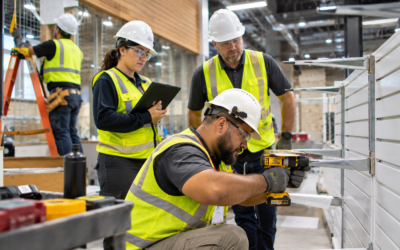

Retail build-out projects involve multiple construction disciplines working together to transform an existing commercial space into a functional retail environment.
Depending on the scope, a project may require demolition crews, electricians, plumbers, HVAC contractors, drywall installers, flooring specialists, painters, millwork installers, fixture teams, and technology professionals.
Each trade has its own responsibilities, equipment, labor requirements, and installation sequence. However, their work is closely connected. An electrical installation may need to be completed before a wall is closed. Flooring may need to be finished before certain fixtures can be installed. Mechanical systems may require coordination with ceiling layouts and other building components.
When these activities are not properly coordinated, one trade can delay another, completed work may need to be reopened, and project schedules can quickly become difficult to maintain.
These challenges become more significant when several specialty contractors are working within the same space or when a retail build-out has a fixed opening deadline.
Successful trade coordination requires more than scheduling subcontractors. It involves defining responsibilities, establishing construction sequences, managing work area access, communicating changes, and verifying that each phase is ready before the next begins.
For general contractors, the objective is to keep every trade aligned with the overall construction plan while maintaining safety, quality, and schedule control.
Why Trade Coordination Matters in Retail Build-Outs
Retail build-outs involve several interconnected construction activities.
Even when each subcontractor performs its assigned work correctly, poor coordination between trades can create delays and installation conflicts.
For example, an electrician may complete wiring in an area before the final fixture layout has been confirmed. A ceiling contractor may begin closing sections before required inspections are completed. A millwork installer may arrive before the necessary electrical connections are available.
These situations can lead to:
- Delayed construction activities
- Conflicting work schedules
- Unnecessary subcontractor remobilization
- Rework and material waste
- Damaged completed installations
- Congested work areas
- Missed inspection windows
- Additional labor costs
- Delayed project turnover
Effective coordination helps prevent these issues by ensuring that trades understand their scopes, dependencies, and responsibilities before work begins.
For additional context, see Retail Build-Outs Explained: From Shell to Store Opening.
1. Define Each Trade’s Scope and Responsibilities
Trade coordination begins with clearly defined scopes of work.
Every subcontractor should understand exactly what it is responsible for completing, where its work begins and ends, and how its activities connect with other construction disciplines.
Scope gaps and overlapping responsibilities can create confusion during execution.
For example, a retail fixture installation may involve several related requirements:
- Fixture assembly and placement
- Electrical connections
- Data and communications connections
- Wall anchoring and blocking
- Final alignment and adjustment
- Testing and verification
If these responsibilities are not clearly assigned, different contractors may assume that another party is handling a particular requirement.
Before mobilization, the general contractor should review each trade’s scope and identify potential overlaps or missing responsibilities.
Important documentation may include:
- Approved construction drawings
- Trade-specific scopes of work
- Equipment schedules
- Fixture and millwork specifications
- Electrical and mechanical requirements
- Project schedules
- Responsibility matrices
- Installation details
Clear scope definition establishes accountability and reduces disputes during construction.
2. Develop a Coordinated Construction Schedule
Each trade should have an individual work schedule, but those schedules must align with the overall construction sequence.
A coordinated schedule identifies when each contractor is expected to mobilize, what work must be completed before its activities begin, and which trades depend on its output.
A typical retail build-out sequence may include:
1. Site preparation and demolition
2. Layout and framing
3. Plumbing, electrical, and HVAC rough-ins
4. Required inspections
5. Drywall and wall finishes
6. Ceiling installation
7. Flooring and finish work
8. Fixture and millwork installation
9. Equipment and technology connections
10. Final testing, inspections, and punch list
11. Final walkthrough and turnover
The actual sequence will depend on the project scope, design, existing conditions, and inspection requirements.
Some activities can proceed simultaneously when the work areas are properly separated and the installation requirements allow it.
However, overlapping trades should not be scheduled simply to shorten the timeline. The project team must confirm that the work can be performed safely without creating interference or rework.
For additional guidance, see Planning for Compressed Construction Schedules.
3. Identify Trade Dependencies Before Work Begins
A construction schedule is only effective when it accounts for dependencies between activities.
Some trades cannot begin until another contractor has completed specific work or provided the required installation conditions.
These dependencies should be identified during preconstruction.
Examples include:
Electrical and drywall: Electrical rough-in, inspections, and required documentation must be completed before affected walls are closed.
HVAC and ceiling systems: Mechanical equipment, ductwork, and related installations must be coordinated with the ceiling layout.
Flooring and fixtures: Flooring requirements and installation sequencing must be coordinated with fixture placement and anchoring details.
Millwork and electrical: Checkout counters, display units, and other fixtures may require coordinated power and data connections.
Technology and furniture: Equipment locations, cable pathways, and network connections must align with the final fixture arrangement.
Identifying these dependencies early helps project managers establish realistic work sequences and avoid unnecessary interruptions.
A trade dependency matrix can be useful for documenting which activities must be completed before another contractor can proceed.
4. Coordinate Electrical, Plumbing, and HVAC Rough-Ins
Mechanical, electrical, and plumbing work often requires coordination before walls, ceilings, and other building components are finished.
These systems may occupy the same spaces or require connections at specific locations.
Poor coordination can result in conflicts involving:
- Conduit and piping pathways
- Ductwork and ceiling heights
- Electrical panel access
- Equipment clearances
- Plumbing connections
- Structural framing
- Access panels
- Lighting and sprinkler layouts
For example, a duct installation may conflict with an electrical pathway if both were planned without reviewing their positions within the available ceiling space.
The project team should review coordinated drawings and confirm critical field dimensions before installation.
Required inspections should also be included in the schedule before affected work is concealed.
Related articles:
5. Coordinate Fixture and Millwork Installation With Other Trades
Fixtures and millwork are major components of many retail build-outs.
Checkout counters, display shelving, service counters, wall systems, and specialty fixtures often depend on the completion of preceding construction activities.
Before fixture installation begins, the project team should verify:
- Flooring completion and protection
- Wall preparation
- Required blocking and anchoring locations
- Electrical connection points
- Data and communications pathways
- Equipment dimensions
- Delivery and staging arrangements
- Required clearances
- Approved installation drawings
Fixture installers should not be expected to resolve construction conditions that should have been addressed by preceding trades.
For example, a checkout counter may require electrical and data connections at specific locations. If those connections are misplaced, the fixture installation may need to be delayed or modified.
Coordinating fixture requirements early helps reduce installation conflicts and protects completed work.
For additional guidance, see Fixture and Millwork Installation Best Practices.
6. Manage Work Area Access and Trade Sequencing
Even when multiple trades are scheduled correctly, they may still encounter conflicts if they need to work in the same area at the same time.
Limited space can create congestion, restrict equipment movement, and increase the risk of damage or safety incidents.
The general contractor should coordinate work area access based on the type of activity being performed.
Considerations include:
- Available working space
- Equipment and material staging
- Required clearances
- Access to electrical and mechanical systems
- Overhead work
- Delivery routes
- Temporary barriers
- Personnel movement
- Safety restrictions
For example, ceiling installation may need to be completed in one section before flooring or fixture crews move into that area.
Similarly, overhead electrical work should be coordinated so that other trades are not working beneath an active installation area without appropriate controls.
Dividing the project into work zones can help manage these conditions.
A zone-based approach allows project managers to control which trades can access specific areas and when those areas are ready for the next phase.
7. Establish Regular Trade Coordination Meetings
Trade coordination should be continuous throughout the project.
A kickoff meeting establishes initial expectations, but construction conditions can change as work progresses.
Regular coordination meetings give project teams an opportunity to review completed activities, upcoming work, outstanding issues, and potential conflicts.
A useful trade coordination meeting should cover:
- Current construction progress
- Completed work and inspections
- Upcoming trade activities
- Work area readiness
- Subcontractor availability
- Material and equipment deliveries
- Required approvals
- Installation conflicts
- Schedule changes
- Safety concerns
- Outstanding action items
Meetings should focus on decisions and issues that affect construction execution.
Each action item should have an assigned owner and target completion date.
This creates accountability and helps prevent unresolved questions from delaying subsequent activities.
For additional guidance, see Communication Strategies for Multi-Location Projects.
8. Use Look-Ahead Scheduling to Prepare Upcoming Activities
A master construction schedule provides the overall timeline, but field teams also need a shorter-term view of upcoming work.
Look-ahead schedules help project managers identify what needs to happen over the next several days or weeks.
These schedules should identify:
- Trades scheduled to mobilize
- Areas expected to become available
- Materials required
- Inspections and approvals
- Equipment needs
- Preceding work requirements
- Potential scheduling conflicts
- Decisions that must be made
For example, if flooring installation is scheduled to begin the following week, the project team should confirm that the underlying preparation work is complete and that the area will be ready.
The same principle applies to fixture installation, electrical connections, and final finishes.
Look-ahead scheduling helps identify problems before crews arrive at the site and discover that they cannot proceed.
9. Coordinate Materials, Equipment, and Deliveries Between Trades
Trade coordination also depends on material readiness.
A subcontractor may have labor available and a confirmed schedule but still be unable to perform its work because required materials or equipment have not arrived.
In retail build-outs, materials may include:
- Electrical components
- Plumbing materials
- HVAC equipment
- Drywall and framing supplies
- Flooring products
- Lighting fixtures
- Millwork
- Store fixtures
- Checkout equipment
- Technology hardware
Deliveries should be coordinated around the construction sequence and available staging space.
The project team should confirm quantities, specifications, delivery dates, and receiving responsibilities.
Materials should also be protected from damage and stored according to applicable requirements.
Where several trades share limited staging areas, the contractor should establish delivery windows and designated storage locations.
This reduces congestion and helps prevent materials from interfering with active construction activities.
10. Maintain Quality Control Between Trade Handoffs
A completed trade activity should not automatically be considered ready for the next contractor.
Before handing over a work area, the project team should verify that the preceding work meets the applicable requirements.
For example:
- Rough-in work should be inspected as required before concealment.
- Wall surfaces should be ready before finish installation.
- Flooring should meet the required condition before fixture installation.
- Electrical connections should be verified before equipment commissioning.
- Fixture installations should be checked before final turnover.
A documented handoff process helps establish that the work area is ready.
The process may include:
- Completion verification
- Required inspection records
- Photographic documentation
- Deficiency identification
- Corrective action assignments
- Approval to proceed
This helps prevent one contractor from inheriting incomplete or defective work from another.
It also provides a clearer record of responsibility when deficiencies arise.
11. Manage Changes and Unexpected Site Conditions
Retail build-outs frequently involve existing commercial structures.
During construction, contractors may encounter conditions that differ from the drawings or initial site assessment.
These may include concealed utilities, unexpected structural conditions, damaged materials, inaccurate dimensions, or undocumented building modifications.
Such discoveries can affect multiple trades.
For example, an unexpected obstruction may require a change to an electrical pathway, which could then affect drywall, ceiling, or fixture installation.
The project team should have a defined process for managing these situations.
Important steps include:
1. Document the existing condition.
2. Identify the affected construction activities.
3. Notify the appropriate project stakeholders.
4. Evaluate potential solutions.
5. Obtain required approvals.
6. Update drawings or instructions when necessary.
7. Communicate the approved change to affected trades.
8. Adjust the schedule and responsibilities.
Subcontractors should not proceed with unapproved changes that could affect other installations or project requirements.
For additional context, see Managing Non-Standard Retail Construction Projects.
12. Coordinate Safety Across All Active Trades
Multiple trades working in the same construction environment create additional safety considerations.
One contractor’s activities may affect the working conditions of another.
Examples include overhead work, electrical installations, material handling, equipment movement, demolition, and temporary access restrictions.
The general contractor should coordinate safety requirements across all participating contractors.
Important considerations include:
- Site-specific safety orientations
- Required personal protective equipment
- Work area separation
- Overhead work coordination
- Electrical hazard controls
- Equipment operating zones
- Material storage
- Housekeeping
- Emergency access
- Hazard reporting
- Daily safety observations
Subcontractors should understand the site-specific hazards and the activities being performed by other trades.
When activities cannot be performed safely at the same time, the project team should adjust the sequence or establish appropriate controls.
Safety should remain part of every coordination discussion, not a separate consideration addressed only during inspections.
Common Trade Coordination Problems in Retail Build-Outs
Even well-planned projects can encounter trade coordination problems.
The following situations deserve particular attention.
Incomplete Scope Definition
Subcontractors may disagree about which contractor is responsible for a particular installation.
Better approach: Define trade boundaries, deliverables, and handoff requirements before mobilization.
Incorrect Work Sequencing
A trade may arrive before preceding activities are complete.
Better approach: Use coordinated schedules and verify work area readiness before confirming mobilization.
Conflicting Installations
Different systems may require the same space or connection point.
Better approach: Review coordinated drawings and verify critical dimensions before installation.
Material and Equipment Delays
Missing components can prevent a subcontractor from completing its assigned work.
Better approach: Coordinate procurement and delivery requirements with the construction schedule.
Poor Work Area Management
Several trades may compete for limited access or staging space.
Better approach: Establish work zones, delivery windows, and access requirements.
Incomplete Trade Handoffs
The next contractor may begin work before preceding installations are verified.
Better approach: Use documented handoff inspections and clear acceptance criteria.
Delayed Communication
Unresolved questions may remain open until they affect construction progress.
Better approach: Establish regular coordination meetings and clear escalation procedures.
How to Measure Trade Coordination Performance
Trade coordination should be evaluated through measurable project results.
Useful performance indicators include:
| Performance Indicator | What It Measures |
| Trade schedule adherence | Completion of assigned activities against planned dates |
| Work area readiness | Percentage of work areas ready before scheduled mobilization |
| Trade handoff time | Time between completion of one activity and the next trade beginning |
| Subcontractor remobilization | Additional mobilizations caused by incomplete or unavailable work areas |
| Rework frequency | Work repeated because of installation or coordination conflicts |
| Inspection pass rate | Percentage of inspections passed on initial review |
| Material readiness | Availability of required materials before scheduled work |
| Schedule variance | Difference between planned and actual milestone dates |
| Deficiency resolution time | Time required to correct identified issues |
| Safety observations | Identification and resolution of jobsite hazards |
Tracking these indicators helps project managers identify recurring coordination problems.
For example, frequent delays between electrical rough-in and drywall installation may indicate that inspection readiness or trade handoffs need improvement.
Similarly, repeated fixture installation delays may point to problems with flooring completion, material availability, or electrical connection locations.
Performance data can help improve scheduling and coordination on future projects.
What to Look for in a General Contractor for Retail Build-Out Coordination
Retailers evaluating a general contractor should consider how effectively the company manages the different construction disciplines involved in a build-out.
Important capabilities include:
Scope coordination: Can the contractor clearly define trade responsibilities and identify overlapping requirements?
Construction scheduling: Does the team maintain coordinated schedules that account for trade dependencies?
Subcontractor management: Can the contractor coordinate qualified trade partners and monitor their performance?
Field supervision: Are site activities monitored by personnel who understand construction sequencing and work area requirements?
Technical coordination: Can the contractor identify conflicts between electrical, mechanical, plumbing, fixture, and technology installations?
Quality control: Are trade handoffs and completed installations inspected?
Safety management: Can the contractor coordinate safe working conditions across multiple trades?
Change management: Does the team have a process for communicating approved changes to affected contractors?
Project communication: Are schedules, issues, and decisions communicated consistently?
Closeout management: Can the contractor coordinate final inspections, deficiencies, and turnover documentation?
A capable general contractor should be able to demonstrate how it manages the relationships between individual trade scopes rather than treating each subcontractor as an independent activity.
How Prime Retail Services Supports Coordinated Retail Build-Outs
Prime Retail Services is a nationwide commercial general contractor supporting construction, renovation, and multi-location programs across retail and other commercial environments.
Retail build-outs require coordination between construction activities, specialty subcontractors, installation teams, and client requirements.
Our approach emphasizes project planning, trade coordination, and consistent execution to help align construction activities from initial preparation through final turnover.
Our capabilities include:
- Remodels and Renovations: Coordinated construction activities within existing commercial facilities.
- Build-Outs and Store Refreshes: Execution of commercial improvements and interior modifications.
- Special Project Rollouts: Coordinated execution for time-sensitive construction requirements.
- Multi-Site FF&E Programs: Management of fixture, furniture, and equipment installations across multiple locations.
- Electrical Coordination: Additional project capabilities through Prime Power Solutions.
- Technology Deployment: Technology installation and infrastructure support through Prime-Net.
Through our proprietary 3P Process, Perfect, Project, Process, we emphasize execution quality, project coordination, and repeatable procedures that support consistent project delivery.
With general contracting licenses in 49 states, excluding Hawaii, Prime Retail Services supports commercial construction requirements across a broad geographic footprint.
Our focus is to help clients coordinate construction resources, manage trade dependencies, and maintain visibility throughout their commercial construction programs.
Frequently Asked Questions
Why is trade coordination important in retail build-out projects?
Trade coordination ensures that different contractors complete their work in the correct sequence, use compatible installation requirements, and meet project milestones without unnecessary conflicts or rework.
Which trades are commonly involved in a retail build-out?
Depending on the project scope, trades may include demolition, framing, electrical, plumbing, HVAC, drywall, painting, flooring, millwork, fixture installation, and technology professionals.
Who is responsible for coordinating subcontractors?
The general contractor typically manages overall construction coordination, including subcontractor schedules, work area access, trade dependencies, quality requirements, and project communication.
What is a trade coordination meeting?
It is a project meeting where contractors review construction progress, upcoming activities, work area readiness, schedule conflicts, material requirements, safety considerations, and outstanding decisions.
How can contractors prevent trade scheduling conflicts?
They can use coordinated schedules, identify dependencies, verify site readiness, manage work zones, and communicate upcoming activities through regular coordination meetings.
Why are trade handoffs important?
Handoffs confirm that one contractor has completed its assigned work and that the area is ready for the next trade. Proper verification reduces the risk of incomplete installations, rework, and disputes.
How does poor trade coordination affect construction costs?
It can result in idle labor, additional mobilization, material waste, damaged completed work, corrective installations, and extended project durations.
How should contractors manage unexpected site conditions?
They should document the condition, evaluate affected trades, obtain required approvals, communicate the approved solution, and update the construction schedule.
Can multiple trades work at the same time during a retail build-out?
Yes, when activities are compatible, work areas are properly separated, and safety requirements are maintained. The contractor should evaluate potential interference before allowing overlapping work.
How can retailers evaluate a general contractor’s trade coordination capabilities?
Retailers should review the contractor’s scheduling process, subcontractor management, field supervision, scope definition, quality controls, safety procedures, and experience coordinating complex commercial projects.
Final Thoughts
Retail build-outs depend on the coordinated execution of multiple construction disciplines.
Each trade has its own responsibilities, but its work must fit into the larger construction sequence. When scopes, schedules, work areas, and handoffs are not properly managed, even relatively straightforward installations can create delays and additional costs.
The most effective approach begins with clear scope definition and continues through coordinated scheduling, field supervision, communication, safety management, and quality verification.
A general contractor must understand not only what each trade needs to accomplish, but also how its work affects the contractors who follow.
Ultimately, successful trade coordination helps keep construction activities aligned, reduces avoidable rework, and supports more predictable retail build-out delivery.
Planning a retail build-out that requires coordination across multiple trades?
Contact Prime Retail Services at info@primeretailservices.com to discuss your next commercial construction project.