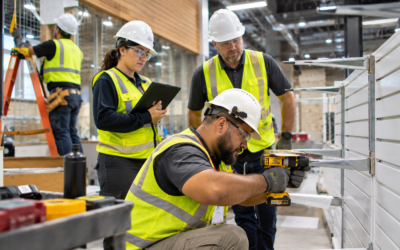
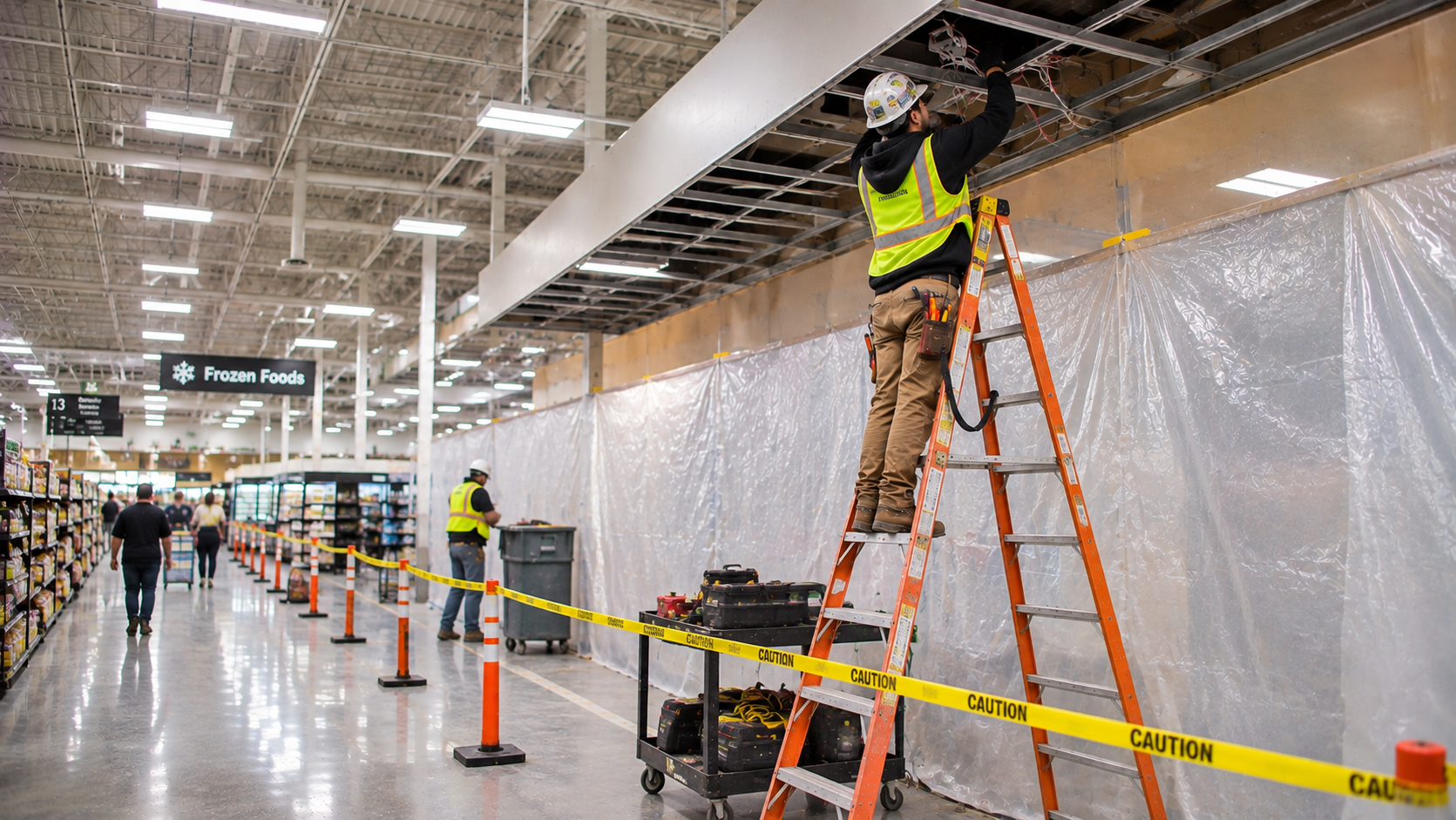
Electrical work is one of the most challenging components of retail construction, particularly when a store must remain open throughout the project.
Renovations may require new circuits, lighting upgrades, panel modifications, equipment connections, and infrastructure improvements. These activities often need to take place while customers are shopping, employees are working, and essential store systems remain operational.
Unlike construction in a vacant facility, electrical work in an active retail environment requires careful coordination between construction activities and daily business operations.
An improperly planned shutdown can interrupt checkout systems, refrigeration, lighting, security equipment, communications, and other critical functions. Exposed wiring, temporary power connections, and restricted electrical work areas can also create safety concerns.
These challenges become more demanding when electrical work overlaps with other construction activities or must be completed within a compressed schedule.
Successfully managing electrical work in open-store projects requires a coordinated approach to preconstruction planning, power management, safety controls, trade coordination, and communication with store management.
The objective is to complete the required electrical improvements while protecting people, maintaining essential operations, and minimizing avoidable downtime.
Why Electrical Work Is More Challenging in Open-Store Projects
Electrical construction in an occupied retail facility involves requirements that extend beyond the installation itself.
The project team must consider how electrical work affects the entire store, including customers, employees, equipment, and existing building systems.
Common challenges include:
-
Maintaining power to essential store operations
-
Scheduling electrical shutdowns
-
Working around energized equipment
-
Managing temporary power arrangements
-
Protecting customers and employees from electrical hazards
-
Coordinating electrical work with other trades
-
Accessing panels and electrical rooms
-
Managing existing wiring and outdated infrastructure
-
Avoiding damage to operating equipment
-
Completing inspections without disrupting business
-
Coordinating work across limited operating windows
A relatively small electrical modification can affect several areas of a store if the circuits or equipment involved are not properly identified.
This makes early planning and communication essential.
For a broader look at electrical work within commercial renovations, see Retail Construction Electrical Scope.
1. Maintaining Power to Critical Store Operations
One of the biggest challenges in open-store electrical construction is maintaining power to systems that support daily business operations.
Retail facilities depend on electrical infrastructure for more than general lighting and convenience outlets.
Critical systems may include:
-
Point-of-sale terminals
-
Checkout counters
-
Refrigeration and freezer equipment
-
Security and CCTV systems
-
Network infrastructure
-
Wireless access points
-
Digital menu boards
-
Emergency and exit lighting
-
HVAC equipment
-
Communications systems
-
Office and administrative equipment
An unplanned interruption can affect store operations, customer service, inventory protection, and employee productivity.
Before electrical work begins, the project team should identify which circuits and equipment are affected.
This may require reviewing electrical drawings, inspecting existing panels, tracing circuits, and coordinating with facility personnel.
The team should also determine whether certain systems require uninterrupted power or an approved temporary arrangement.
Critical equipment should not be disconnected until the appropriate stakeholders understand the impact and approve the work.
2. Planning Electrical Shutdowns Around Store Hours
Some electrical activities require equipment or circuits to be de-energized.
However, shutting down power during normal business hours may interrupt store operations or create unacceptable conditions for customers and employees.
The project team should evaluate shutdown requirements during preconstruction and coordinate them with store management.
Important considerations include:
-
Which equipment or circuits will be affected
-
Whether the affected systems support critical operations
-
How long the shutdown is expected to last
-
Whether temporary power is required
-
Whether the work can be completed after hours
-
Required notifications and approvals
-
Procedures for restoring power
-
Verification that affected systems operate correctly afterward
Shutdowns should be scheduled during approved windows whenever practical.
For example, work affecting checkout equipment may need to take place after the store closes or during a planned operational window.
The contractor should also establish a restoration plan before the shutdown begins.
This includes identifying who is responsible for verifying that equipment, lighting, communications, and other affected systems are functioning before the store resumes normal operations.
For related guidance, see Best Practices for After-Hours Retail Construction.
3. Managing Temporary Power During Construction
Temporary power may be necessary when existing electrical systems are modified or when construction activities require power in areas where permanent connections are unavailable.
In an active retail environment, temporary electrical arrangements must be carefully managed to avoid creating additional hazards.
Potential applications include:
-
Temporary construction lighting
-
Power for approved construction equipment
-
Temporary connections for designated work areas
-
Power arrangements during phased electrical upgrades
-
Temporary support for affected operational equipment, where appropriate
Temporary installations should be designed and maintained in accordance with applicable electrical and safety requirements.
Important precautions include:
-
Using properly rated temporary electrical equipment
-
Protecting cables from physical damage
-
Keeping connections away from customer traffic
-
Using appropriate ground-fault protection
-
Avoiding overloaded circuits
-
Maintaining required clearances
-
Securing temporary distribution equipment
-
Inspecting temporary installations regularly
-
Restricting access to authorized personnel
Cables should not be left exposed across public walkways or placed where carts, merchandise, or equipment can damage them.
When temporary power is used to support store operations, the arrangement should be evaluated by qualified electrical personnel to confirm that it is appropriate for the connected equipment and expected load.
4. Working Safely Around Energized Electrical Systems
Retail stores often contain electrical systems that cannot be taken out of service without affecting business operations.
This may require construction teams to work near energized equipment or coordinate activities around systems that remain operational.
However, the need to maintain store operations does not justify unnecessary exposure to electrical hazards.
The project team should determine whether equipment can be safely de-energized before work begins.
When work around energized systems is necessary and permitted, it must be performed by qualified personnel under appropriate procedures and controls.
Important considerations include:
-
Identifying electrical hazards before work begins
-
Establishing restricted-access areas
-
Maintaining required approach boundaries
-
Using appropriate protective equipment
-
Following applicable electrical safety procedures
-
Implementing lockout/tagout when required
-
Protecting exposed conductors and components
-
Preventing unauthorized access
-
Maintaining appropriate supervision
Electrical panels, switchgear, and distribution equipment should remain accessible only to authorized personnel.
Customers and store employees should never be exposed to open electrical enclosures, unsecured wiring, or active electrical work areas.
For projects involving multiple technical installations, see Coordinating Electrical and Low-Voltage Work in Remodels.
5. Identifying Existing Electrical Infrastructure and Hidden Conditions
Existing retail buildings do not always have complete or accurate electrical documentation.
During renovations, contractors may encounter outdated wiring, undocumented circuit modifications, limited panel capacity, or infrastructure that differs from the original drawings.
These conditions can complicate electrical work and introduce unexpected schedule requirements.
Before construction begins, the project team should evaluate:
-
Existing electrical distribution
-
Panel schedules and circuit identification
-
Available electrical capacity
-
Existing equipment connections
-
Conduit and cable pathways
-
Grounding and bonding arrangements
-
Emergency power systems
-
Existing lighting controls
-
Electrical room access
-
Potential concealed conditions
Field verification is particularly important before connecting new equipment or modifying existing circuits.
For example, an equipment installation may require a dedicated circuit, but the existing electrical distribution may not have sufficient capacity or an available connection point.
Identifying these conditions early helps prevent last-minute design changes and unnecessary interruptions.
Where necessary, the contractor should coordinate additional assessments with qualified electrical professionals and the appropriate design team.
6. Coordinating Electrical Work With Other Construction Trades
Electrical work rarely takes place independently during a retail renovation.
It often overlaps with framing, drywall, ceiling installation, mechanical work, flooring, fixture installation, and technology deployment.
These activities must be properly sequenced to prevent conflicts and rework.
Common coordination requirements include:
-
Confirming electrical rough-in locations before walls are closed
-
Coordinating lighting layouts with ceiling systems
-
Aligning equipment connections with fixture dimensions
-
Confirming power requirements for mechanical equipment
-
Coordinating data and power connections at checkout counters
-
Verifying electrical pathways before final finishes
-
Completing required inspections before covering concealed work
For example, a new checkout counter may require power and data connections at specific locations.
If the electrical contractor does not coordinate with the fixture installer and technology team, the final installation may require additional wiring or modifications to completed millwork.
Trade coordination meetings, approved drawings, and documented installation requirements help prevent these problems.
Related articles:
7. Protecting Point-of-Sale and Technology Infrastructure
Modern retail operations depend heavily on technology.
Checkout systems, network equipment, wireless access points, CCTV systems, and digital displays all require reliable electrical and communications infrastructure.
Electrical modifications can affect these systems even when the technology equipment itself is not part of the construction scope.
For example, disconnecting a circuit may affect network hardware or equipment supporting multiple checkout stations.
The project team should identify technology dependencies before electrical work begins.
Important considerations include:
-
Confirming power requirements
-
Identifying dedicated circuits
-
Verifying equipment locations
-
Coordinating data and power pathways
-
Protecting network equipment
-
Planning approved shutdowns
-
Testing affected systems after restoration
-
Coordinating with the retailer’s IT representatives
Technology equipment should not be assumed to be unaffected simply because it is located outside the immediate construction area.
Electrical and technology teams should work from coordinated requirements to avoid unexpected disruptions.
For additional context, see Benefits of Self-Performing Electrical and Low-Voltage Work.
8. Managing Lighting During Electrical Renovations
Lighting is essential to both store operations and customer safety.
Electrical renovations may involve replacing fixtures, relocating lighting, upgrading controls, or modifying circuits.
However, work that affects store lighting must be carefully coordinated.
Potential challenges include:
-
Temporary loss of illumination
-
Uneven lighting levels
-
Incomplete emergency lighting
-
Exposed ceiling wiring
-
Fixture installation conflicts
-
Lighting control interruptions
-
Changes to customer pathways
The contractor should determine how lighting will be maintained in occupied areas during construction.
If a lighting circuit must be disconnected, alternative illumination may be necessary where required to maintain safe conditions.
Emergency and exit lighting must receive particular attention.
Required life safety systems should not be disabled or compromised without the appropriate coordination, authorization, and temporary protection measures.
Before reopening an affected area, the team should verify that required lighting and controls are functioning as intended.
9. Coordinating Electrical Inspections and Required Approvals
Electrical installations must meet applicable codes, permitting requirements, and inspection procedures.
In open-store projects, coordinating these requirements can be challenging because inspections may affect the availability of work areas or operating systems.
The project team should identify required inspections during preconstruction and include them in the project schedule.
Depending on the scope, this may involve:
-
Electrical rough-in inspections
-
Service and panel inspections
-
Equipment connection verification
-
Final electrical inspections
-
Required testing
-
Documentation and approval
-
Coordination with the authority having jurisdiction
The contractor should ensure that work is ready for inspection before scheduling the appropriate authority.
Incomplete installations, inaccessible equipment, or missing documentation can result in failed inspections and additional visits.
Inspection requirements should not be bypassed to recover schedule time.
The project team should coordinate inspection windows with store operations and the relevant facility representatives.
10. Protecting Customers and Employees From Electrical Hazards
When construction takes place in an active store, electrical hazards must be isolated from public areas.
Customers and employees are generally unfamiliar with the work being performed and may not recognize electrical hazards within a construction zone.
The contractor should establish appropriate physical separation and access controls.
Safety measures may include:
-
Secure temporary barriers
-
Restricted-access electrical work areas
-
Warning signs
-
Controlled equipment access
-
Protected cable routing
-
Proper material storage
-
Covered or secured electrical components
-
Adequate lighting
-
Daily safety inspections
-
Housekeeping procedures
Electrical work should not create exposed hazards in customer aisles, employee pathways, or other occupied areas.
If the work cannot be safely separated from the public, the affected area should be closed, or the activity should be rescheduled.
For more information, see Safety Considerations for Open-Store Construction.
11. Scheduling Electrical Work During Compressed Construction Windows
Retailers often need electrical upgrades completed within limited construction windows.
A store may have only a few hours available after closing, or electrical work may need to be coordinated with a phased renovation schedule.
These constraints make labor availability, material readiness, and work sequencing particularly important.
Before confirming an electrical work window, the project team should verify:
-
Approved scope and drawings
-
Required permits and approvals
-
Qualified personnel availability
-
Material and equipment readiness
-
Site access arrangements
-
Shutdown requirements
-
Required preceding work
-
Inspection coordination
-
Restoration procedures
-
Contingency arrangements
Electrical crews should not be mobilized before the work area and required materials are ready.
Similarly, activities should be sequenced so that electrical installations do not conflict with other trades or require completed work to be reopened.
For additional guidance, see Planning for Compressed Construction Schedules.
12. Establish Clear Communication Between Contractors and Store Management
Electrical work can affect store operations in ways that are not immediately visible to construction personnel.
Store management may understand which systems are essential during specific operating periods, while the electrical contractor understands the technical requirements of the work.
Both perspectives are necessary.
A communication plan should establish:
-
Designated construction contacts
-
Store management representatives
-
Electrical work schedules
-
Planned shutdowns
-
Affected equipment and systems
-
Required notifications
-
Emergency procedures
-
Power restoration responsibilities
-
Testing and verification requirements
-
Escalation procedures
Changes to the electrical work schedule should be communicated promptly to everyone affected.
The team should also confirm when electrical systems are safe to return to normal operation.
This reduces the likelihood of unexpected outages and helps store personnel prepare for any temporary limitations.
Common Electrical Challenges in Open-Store Projects
Even well-planned electrical renovations can encounter unexpected issues.
The following challenges deserve particular attention.
Unplanned Power Interruptions
An unidentified circuit or unexpected electrical dependency can affect systems beyond the immediate work area.
How to address it: Verify affected circuits, review available documentation, and coordinate shutdowns before beginning work.
Insufficient Electrical Capacity
Existing panels or distribution equipment may not support new equipment requirements.
How to address it: Evaluate electrical capacity early and coordinate necessary upgrades with qualified electrical professionals.
Incomplete Existing Documentation
Outdated drawings and undocumented modifications can complicate field execution.
How to address it: Perform field verification and document existing conditions before finalizing the work plan.
Temporary Power Hazards
Improper cable routing, overloaded circuits, or unsecured connections can create additional risks.
How to address it: Use properly designed temporary installations and inspect them regularly.
Conflicts With Other Trades
Electrical installations may overlap with ceiling, mechanical, fixture, or technology work.
How to address it: Establish coordinated drawings, work sequences, and clear trade handoff requirements.
Delayed Inspections
Incomplete work or missing documentation may prevent required inspections from proceeding.
How to address it: Identify inspection requirements early and verify readiness before scheduling.
Disruption to Critical Store Systems
Electrical modifications may affect checkout equipment, refrigeration, communications, or security systems.
How to address it: Identify operational dependencies and coordinate approved shutdown and restoration procedures.
How to Measure Electrical Project Performance in Open Stores
Electrical project performance should be measured through more than installation completion.
The project team should evaluate whether work was completed safely, met technical requirements, and maintained the expected level of operational continuity.
| Performance Indicator | What It Measures |
| Shutdown duration | Actual interruption time compared with the approved window |
| Schedule adherence | Completion of electrical activities against planned milestones |
| Power restoration | Timely and successful return of affected systems to operation |
| Inspection performance | Completion and approval of required inspections |
| First-pass quality | Work accepted without corrective action |
| Rework frequency | Additional labor required to resolve installation issues |
| Safety observations | Identification of electrical and jobsite hazards |
| Operational disruption | Impact of construction activities on store operations |
| Material readiness | Availability of required electrical components |
| Closeout completion | Delivery of required testing and project documentation |
Tracking these indicators helps project teams identify recurring issues and improve planning for future locations.
What to Look for in a General Contractor for Open-Store Electrical Projects
Retailers should evaluate whether a general contractor can coordinate electrical construction within an operating commercial environment.
Important considerations include:
Electrical coordination experience: Does the contractor understand how electrical work affects other construction activities and store systems?
Qualified electrical resources: Can the contractor coordinate appropriately licensed electrical professionals for the required scope?
Shutdown planning: Does the team identify affected circuits, equipment dependencies, and approved work windows?
Temporary power management: Can the contractor coordinate safe temporary electrical arrangements when needed?
Trade coordination: Can electrical work be aligned with mechanical, fixture, millwork, and technology installations?
Operational awareness: Does the contractor understand the importance of maintaining critical store systems?
Safety management: Are electrical work areas properly isolated and monitored?
Inspection coordination: Does the contractor account for required permits, inspections, and approvals?
Project oversight: Can the team maintain visibility across electrical work, construction schedules, and operational requirements?
The right construction partner should be able to demonstrate how electrical work fits into the overall project execution strategy.
How Prime Retail Services Supports Electrical Coordination in Retail Construction
Prime Retail Services is a nationwide commercial general contractor supporting construction, renovation, and multi-location programs across retail and other commercial environments.
Electrical work in an operating store requires coordination between construction activities, qualified electrical resources, existing infrastructure, and daily business requirements.
Our approach emphasizes planning, trade coordination, and project oversight to help align electrical requirements with the broader construction scope.
Our capabilities include:
-
Remodels and Renovations: Coordinated construction activities within existing commercial facilities.
-
Build-Outs and Store Refreshes: Execution of commercial improvements and interior modifications.
-
Special Project Rollouts: Coordinated execution for time-sensitive construction requirements.
-
Multi-Site FF&E Programs: Management of fixture, furniture, and equipment installations across multiple locations.
-
Electrical Coordination: Additional electrical project capabilities through Prime Power Solutions.
-
Technology Deployment: Technology installation and infrastructure support through Prime-Net.
Through our proprietary 3P Process, Perfect, Project, Process, we emphasize execution quality, project coordination, and repeatable procedures that support consistent project delivery.
With general contracting licenses in 49 states, excluding Hawaii, Prime Retail Services supports commercial construction requirements across a broad geographic footprint.
Our focus is to help clients coordinate complex construction requirements, manage field execution, and maintain visibility throughout their projects.
Frequently Asked Questions
What makes electrical work difficult in open-store projects?
Electrical work must be coordinated around operating equipment, customers, employees, store hours, and existing electrical systems. Even a limited modification can affect critical store operations if it is not properly planned.
Can electrical work be performed while a retail store remains open?
Yes, when the work can be safely isolated and coordinated with store operations. Activities that require disruptive shutdowns or cannot be adequately separated from the public may need to be performed after hours.
How do contractors prevent power interruptions during retail renovations?
They identify affected circuits, verify equipment dependencies, coordinate shutdowns, use approved temporary power arrangements when appropriate, and establish procedures for testing and restoring affected systems.
Why is temporary power important during open-store construction?
Temporary power may support construction equipment, lighting, or approved operational needs while permanent electrical systems are being modified. It must be properly designed, installed, protected, and maintained.
What happens when existing electrical infrastructure cannot support new equipment?
The project team may need to evaluate the available capacity and coordinate electrical upgrades or other approved solutions with qualified professionals and the design team.
How should contractors protect customers during electrical work?
They should establish appropriate barriers, restrict access to electrical work areas, protect cables and equipment, maintain safe walkways, and ensure exposed electrical components are not accessible to the public.
Why should electrical work be coordinated with low-voltage installations?
Power and data requirements often serve the same equipment and fixtures. Coordinating both scopes helps prevent conflicting pathways, incorrect connection locations, and installation rework.
Should electrical shutdowns take place after store hours?
When practical, disruptive electrical work should be scheduled during approved non-operating hours. The actual timing depends on the affected systems, operational requirements, and safety considerations.
Who can perform electrical work in a retail construction project?
Electrical work must be performed by appropriately qualified personnel in accordance with applicable licensing requirements, electrical codes, and safety regulations.
How can retailers reduce electrical construction delays?
Early site assessments, accurate scope definition, material readiness, qualified electrical resources, coordinated scheduling, and timely approvals can reduce avoidable delays.
Final Thoughts
Electrical work in open-store projects requires a careful balance between construction progress and operational continuity.
Maintaining power to critical systems, coordinating shutdowns, managing temporary installations, protecting customers, and aligning multiple trades all contribute to successful execution.
The greatest challenges often arise when electrical requirements are treated as isolated installations rather than part of the broader construction plan.
By identifying operational dependencies early and coordinating electrical activities with store management, specialty contractors, and other construction trades, project teams can reduce avoidable disruptions and maintain better control over the work.
The objective is to complete the required electrical improvements safely while keeping the store’s essential operations functioning as intended.
Planning electrical work for an active retail location?
Contact Prime Retail Services at info@primeretailservices.com to discuss your next commercial construction project.