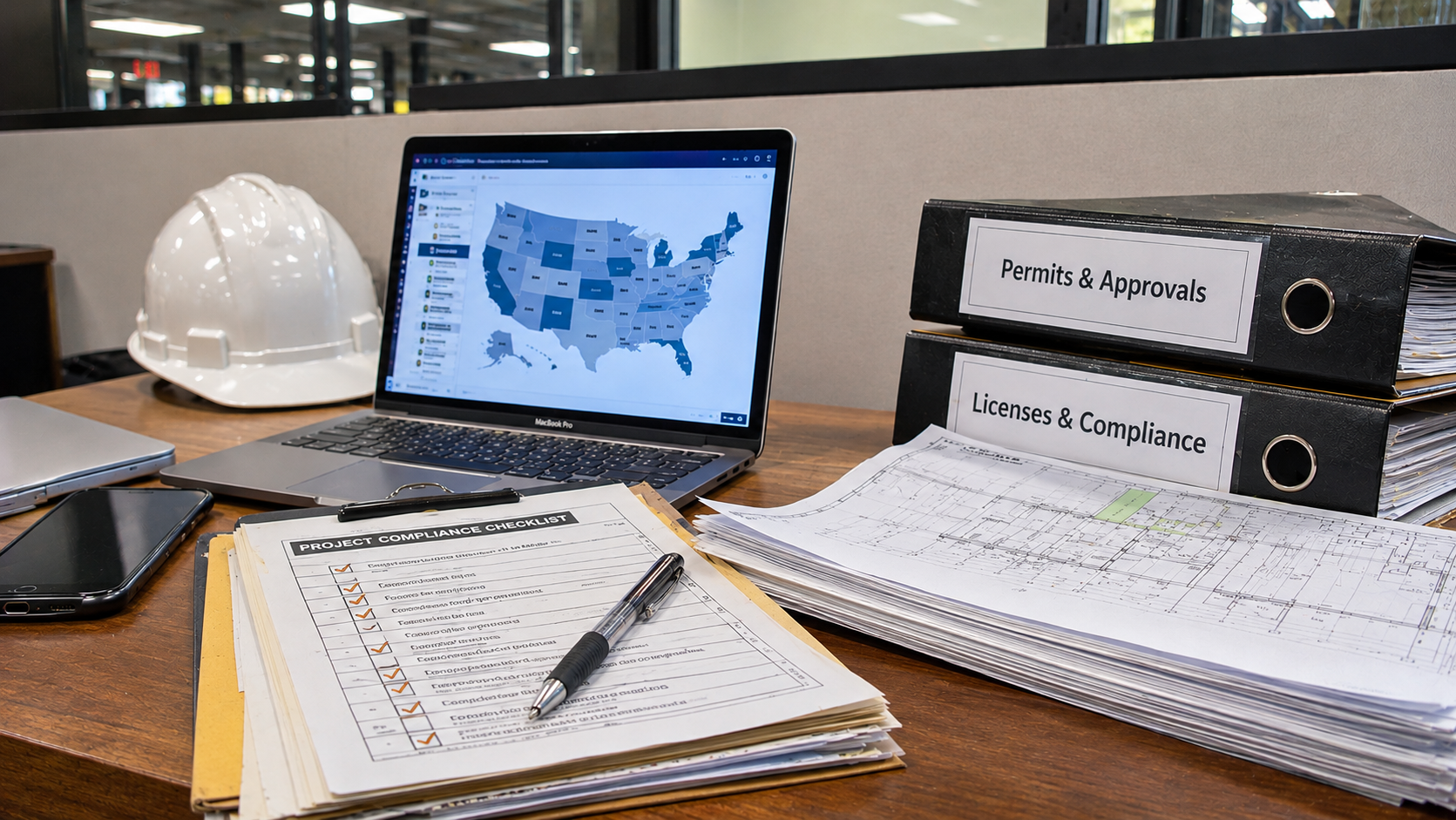
Managing commercial construction projects across multiple states involves more than coordinating crews, materials, and construction schedules. General contractors must also navigate a complex network of licensing requirements, building codes, permits, inspections, and local regulations.
A construction activity that is permitted under one jurisdiction’s requirements may involve different documentation, approvals, or inspection procedures in another. Even neighboring cities can have different application processes, review timelines, and enforcement practices.
These differences become increasingly important for retailers and commercial organizations expanding or renovating locations nationwide.
A multi-state construction program may involve dozens of jurisdictions, each with its own permitting authorities and compliance expectations. Without a consistent process for identifying and managing these requirements, projects can experience delayed mobilization, failed inspections, unnecessary rework, and interruptions to planned construction activities.
The challenge is not simply obtaining permits. It is understanding which requirements apply to each location, confirming that the appropriate contractors are authorized to perform the work, and maintaining compliance throughout the project.
Successful nationwide construction programs require early regulatory planning, jurisdiction-specific research, qualified local resources, centralized documentation, and consistent communication.
Why Permits and Compliance Become More Complex Across Multiple States
Construction requirements are not administered through one uniform national permitting system.
Depending on the location and scope, a project may be subject to requirements established by state agencies, counties, municipalities, local building departments, fire authorities, and other regulatory bodies.
A retail remodel in one state may require a particular permit package and inspection sequence, while a similar project in another state may follow a different process.
Requirements may also vary within the same state.
For example, a city may administer building permits locally, while another jurisdiction may rely on a county building department. Certain projects may also require separate approvals for electrical, plumbing, mechanical, fire protection, signage, or other regulated work.
Common compliance challenges include:
-
State-specific contractor licensing requirements
-
Local business registration requirements
-
Building and construction permits
-
Electrical, plumbing, and mechanical permits
-
Fire and life-safety approvals
-
Zoning and signage requirements
-
Accessibility standards
-
Energy code requirements
-
Inspection scheduling and documentation
-
Permit expiration and renewal requirements
-
Local amendments to adopted building codes
-
Special requirements for occupied commercial facilities
These requirements must be evaluated based on the actual project location and scope.
A contractor cannot assume that an approval obtained for one store automatically applies to another location, even when the construction plans are similar.
For additional context on nationwide construction operations, see Nationwide Construction Program Management.
1. Understand the Licensing Requirements in Each Jurisdiction
Contractor licensing is one of the first compliance considerations when planning construction across multiple states.
A general contractor may need to meet state licensing requirements before entering into certain construction agreements or performing regulated work. Some states also impose local registration, permitting, or additional qualification requirements.
Licensing rules can depend on:
-
Type of construction work
-
Project value
-
Project classification
-
Contractor business structure
-
State licensing categories
-
Local registration requirements
-
Specialty trade activities
-
Applicable exemptions
The project team should identify which licenses and registrations are required before assigning work.
It is also important to distinguish between general contracting and specialty trade licensing.
A general contractor license does not automatically authorize a company to perform every regulated electrical, plumbing, HVAC, or other specialty activity. Those scopes may require separate licenses or appropriately qualified subcontractors.
For multi-state programs, a licensing matrix can help track the requirements associated with each jurisdiction.
A useful matrix may include:
| Compliance Item | Information to Track |
| State | State where the project is located |
| Local jurisdiction | City, county, or other applicable authority |
| Contractor license | Required license classification |
| License holder | Responsible licensed contractor or entity |
| License status | Current, pending, or renewal required |
| Local registration | Additional registration requirements |
| Specialty trades | Separate trade licensing requirements |
| Expiration date | License or registration renewal deadline |
| Verification | Date and source of license confirmation |
Licensing information should be verified through the appropriate state or local licensing authority rather than relying solely on historical project records.
2. Identify the Permits Required for Each Project Scope
Not every commercial construction project requires the same permits.
A project involving cosmetic improvements may have different approval requirements from one involving structural modifications, electrical upgrades, plumbing changes, or significant mechanical work.
Before mobilization, the general contractor should review the proposed scope and identify the permits that may apply.
Common permit categories include:
Building permits: May be required for structural modifications, alterations, additions, and other regulated construction activities.
Electrical permits: May apply to new circuits, service modifications, electrical equipment, lighting systems, and other regulated electrical work.
Plumbing permits: May be required for changes to water supply, drainage, plumbing fixtures, and related systems.
Mechanical permits: May apply to HVAC equipment, ventilation systems, ductwork, and other mechanical installations.
Fire and life-safety approvals: May involve fire alarm systems, sprinkler modifications, egress requirements, and other life-safety considerations.
Signage permits: May be required for exterior signs, illuminated signs, or certain interior and exterior modifications.
Specialty permits: Depending on the jurisdiction and project, additional approvals may be required for demolition, temporary structures, environmental considerations, or other regulated activities.
The project team should not assume that a permit is unnecessary simply because the work appears minor.
The applicable authority should be consulted when the requirements are unclear.
Related article: Retail Construction Electrical Scope.
3. Research Local Building Codes and Jurisdiction-Specific Requirements
Building codes establish minimum requirements for construction, safety, accessibility, and building systems.
However, the specific codes adopted and enforced can vary by jurisdiction.
States and local authorities may adopt different editions of model building codes, make local amendments, or establish additional requirements.
The project team should determine which code provisions apply to the location and the type of work being performed.
Areas that may require review include:
-
Structural requirements
-
Electrical installations
-
Plumbing systems
-
Mechanical and ventilation systems
-
Fire protection
-
Means of egress
-
Accessibility
-
Energy efficiency
-
Occupancy classifications
-
Construction safety requirements
Existing commercial buildings introduce additional considerations.
A remodel may involve existing systems that were installed under earlier code requirements. Whether an existing condition must be upgraded can depend on the scope of work, applicable codes, and the authority having jurisdiction.
The contractor should not assume that all existing conditions must automatically be brought up to current standards, nor should it assume that existing installations are exempt from review.
These questions should be evaluated with the appropriate design professionals and regulatory authorities.
4. Verify Permit Requirements Before Scheduling Mobilization
Permit delays can affect the entire construction schedule.
If a crew is mobilized before the required approvals are obtained, the project may be unable to proceed with certain activities.
This can result in idle labor, additional travel expenses, subcontractor rescheduling, and delayed completion.
A preconstruction compliance review should take place before mobilization.
The review should confirm:
-
Applicable permit requirements
-
Responsible permit applicants
-
Required application documents
-
Approved construction drawings
-
Supporting engineering documents, when required
-
Permit application status
-
Expected review timelines
-
Required approvals before work begins
-
Inspection requirements
-
Any restrictions on construction activities
The project schedule should account for the actual permitting process.
Permit review durations should not be treated as identical across locations. Some jurisdictions may offer established electronic submission processes, while others may require additional documentation or in-person coordination.
A location should be considered ready for mobilization only when the required preconstruction approvals and site conditions have been verified.
For additional guidance, see Planning for Compressed Construction Schedules.
5. Coordinate Specialty Trade Licensing and Permits
Multi-state construction projects often involve several specialty trades.
Electrical, plumbing, mechanical, fire protection, and other regulated activities may be subject to licensing and permit requirements separate from general contracting.
This creates an additional coordination responsibility for the general contractor.
Before assigning specialty work, the project team should verify:
-
Required trade license classifications
-
License holder and responsible party
-
Local registration requirements
-
Permit application responsibilities
-
Required inspections
-
Applicable qualifications
-
Insurance and compliance documentation
-
Any jurisdiction-specific restrictions
The contractor should also establish which party is responsible for obtaining each permit.
For example, an electrical subcontractor may be responsible for obtaining an electrical permit in one jurisdiction, while the application process or responsible license holder may differ elsewhere.
These responsibilities should be documented before work begins.
Clear assignments help prevent permit applications from being overlooked or duplicated.
Related articles:
6. Understand Inspection Requirements and Approval Milestones
Obtaining a permit does not necessarily mean that all construction activities can proceed without additional regulatory review.
Many projects require inspections at specific stages of construction.
The inspection sequence depends on the scope, applicable codes, and local authority requirements.
Common inspection categories may include:
-
Building and structural inspections
-
Electrical rough-in inspections
-
Plumbing inspections
-
Mechanical inspections
-
Fire and life-safety inspections
-
Final building inspections
-
Final trade inspections
Certain installations must be inspected before they are concealed or covered by subsequent construction activities.
For example, electrical or plumbing work may require inspection before walls or ceilings are closed.
The contractor should identify these inspection points during preconstruction and incorporate them into the project schedule.
Inspection coordination should include:
1. Confirming the applicable inspection requirements.
2. Identifying the responsible party.
3. Verifying that the work is ready for inspection.
4. Scheduling the inspection with the appropriate authority.
5. Providing required documentation.
6. Recording the inspection result.
7. Addressing deficiencies when identified.
8. Obtaining approval before proceeding where required.
Inspection records should be maintained with the project documentation.
This creates a clear record of regulatory approvals and helps prevent uncertainty during closeout.
7. Maintain a Centralized Compliance Tracking System
Managing permits and licensing requirements across multiple states can generate a substantial amount of documentation.
Without a centralized tracking process, project teams may struggle to determine which approvals have been obtained and which requirements remain outstanding.
A centralized compliance tracker provides visibility into the status of each location.
It may include:
-
Project address and jurisdiction
-
Applicable permitting authority
-
Required permits
-
Permit application status
-
Permit numbers
-
Issuance dates
-
Expiration dates
-
Required inspections
-
Inspection results
-
Contractor license information
-
Specialty trade qualifications
-
Required supporting documents
-
Outstanding compliance items
-
Responsible personnel
The tracker should be updated as applications are submitted, permits are issued, inspections are completed, and requirements change.
A centralized system also makes it easier to identify recurring issues across multiple jurisdictions.
For example, if several locations require additional documentation for similar electrical work, project leadership can identify the pattern and incorporate the requirement into future preconstruction reviews.
For additional information on maintaining consistent program oversight, see How Centralized Oversight Improves Consistency.
8. Coordinate With Local Authorities and Building Departments
Even with a standardized internal process, local regulatory coordination remains essential.
The authority having jurisdiction, commonly referred to as the AHJ, is responsible for administering and enforcing applicable requirements within its area of authority.
Depending on the project, the AHJ may be a municipal building department, county authority, state agency, fire authority, or another designated regulatory body.
The project team should establish the appropriate points of contact and understand the local submission and review process.
Questions to clarify may include:
-
Which permits are required?
-
Which forms and documents must be submitted?
-
Are electronic applications accepted?
-
Which contractor licenses are required?
-
Are separate trade permits necessary?
-
What inspections must be scheduled?
-
Are there special requirements for occupied commercial facilities?
-
What documentation is required for final approval?
-
Are there local amendments that affect the project?
Early communication can help identify requirements that may not be obvious from the original project scope.
However, informal guidance should not be treated as a substitute for required written approvals, permit documents, or official determinations.
9. Account for Accessibility, Fire, and Life-Safety Requirements
Retail construction projects must account for requirements that affect how customers, employees, and emergency personnel use the facility.
Depending on the project scope, accessibility, fire protection, and life-safety considerations may be subject to federal, state, and local requirements.
Areas that may require review include:
Accessibility: Changes to entrances, accessible routes, service counters, restrooms, parking facilities, and other regulated elements may trigger accessibility considerations.
Fire protection: Work affecting sprinkler systems, fire alarm systems, fire-rated assemblies, or other fire protection features may require specialized coordination and approvals.
Means of egress: Changes to layouts, partitions, doors, or circulation paths may affect exit access and occupant movement.
Emergency systems: Construction activities involving emergency lighting, exit signage, alarms, or related systems may require additional review and testing.
The project team should identify these considerations during design and preconstruction rather than waiting until final inspection.
Where required, qualified design professionals and specialty contractors should review the proposed work.
10. Manage Permit Revisions and Scope Changes
Construction requirements can change after the original permit application has been submitted or approved.
A field condition may require a design adjustment. A client may request a scope change. An inspection may identify a deficiency that requires revised documentation.
These changes can affect the validity or scope of existing approvals.
Before implementing a change, the project team should determine whether it requires:
-
Revised construction drawings
-
Additional engineering documentation
-
Permit revisions
-
Additional trade permits
-
Updated inspections
-
New approvals
-
Revised contractor assignments
The project team should not assume that an existing permit automatically covers every subsequent modification.
Changes should be reviewed against the applicable jurisdiction’s requirements.
The approved revisions should then be communicated to affected subcontractors and incorporated into the project records.
For related guidance, see Managing Non-Standard Retail Construction Projects.
11. Plan for Differences Between Occupied and Unoccupied Facilities
Retail construction frequently takes place within existing commercial buildings.
Some locations remain open during renovations, while others may be closed or partially restricted during construction.
These operating conditions can affect permitting, inspections, access, safety controls, and construction sequencing.
For occupied facilities, project teams may need to coordinate:
-
Customer and employee access
-
Construction barriers
-
Temporary egress arrangements
-
Work-hour restrictions
-
Noise and dust controls
-
Fire protection system impairments
-
Utility interruptions
-
Delivery access
-
Inspection access
-
Emergency procedures
Requirements should be verified with the applicable authority and facility representatives.
Any temporary impairment of a life-safety system should follow applicable approval, notification, and protection procedures.
The construction schedule should account for these restrictions before work begins.
Related articles:
12. Monitor Compliance Throughout Construction
Compliance is not a one-time activity completed during preconstruction.
Requirements must continue to be monitored as construction progresses.
Permits may have expiration dates, inspections may need to be rescheduled, and changes in scope may require additional approvals.
The project team should maintain ongoing oversight of:
-
Permit validity
-
License status
-
Required inspections
-
Approved construction documents
-
Scope changes
-
Field conditions
-
Regulatory notices
-
Inspection deficiencies
-
Corrective actions
-
Final approvals
Subcontractors should also understand which requirements apply to their assigned work.
Regular compliance reviews help identify missing documentation and outstanding approvals before they affect project completion.
For programs involving several locations, these reviews should be incorporated into the overall project reporting process.
13. Prepare Complete Compliance Documentation for Closeout
Project closeout should include verification that applicable permits, inspections, and regulatory requirements have been addressed.
Incomplete documentation can create uncertainty about whether the work received the necessary approvals.
Depending on the project and jurisdiction, closeout records may include:
-
Issued permits
-
Approved drawings
-
Permit revisions
-
Inspection reports
-
Final inspection approvals
-
Trade certifications
-
Testing and commissioning records
-
Required compliance documentation
-
Certificate of occupancy or other applicable completion documentation, when required
-
Outstanding corrective action records
-
Final project closeout information
Not every project requires the same closeout documents.
The project team should identify the applicable requirements during preconstruction and track them through completion.
A standardized closeout checklist can help ensure that every location receives the appropriate documentation.
Common Mistakes When Coordinating Permits Across Multiple States
Even experienced construction teams can encounter compliance problems when managing projects across different jurisdictions.
Assuming Requirements Are the Same Everywhere
Similar projects may be subject to different local application, licensing, and inspection requirements.
Better approach: Verify applicable requirements for every project location.
Treating a General Contractor License as Authorization for All Trade Work
Specialty trades may require separate licenses and qualified personnel.
Better approach: Verify licensing requirements for each assigned scope.
Applying for Permits Too Late
Late applications can delay mobilization and affect the overall construction schedule.
Better approach: Include permitting research and submission milestones in preconstruction planning.
Overlooking Local Amendments
A jurisdiction may adopt additional requirements beyond the base code edition.
Better approach: Confirm the applicable code and local amendments with the appropriate authority.
Failing to Schedule Required Inspections
Construction may be unable to proceed when required inspections have not been completed.
Better approach: Identify inspection milestones and responsible parties before work begins.
Losing Track of Permit Expiration Dates
Expired permits may require renewal or other action before work can continue.
Better approach: Maintain a centralized permit tracker with expiration dates and assigned owners.
Making Unapproved Field Changes
A construction modification may affect the approved permit scope.
Better approach: Review proposed changes against applicable approval requirements before implementation.
Incomplete Closeout Documentation
Missing inspection records or approvals can delay project turnover.
Better approach: Track required compliance documents throughout construction rather than collecting everything at the end.
How to Build a Scalable Multi-State Compliance Process
A nationwide construction program needs a repeatable process for managing jurisdiction-specific requirements.
A practical compliance framework can be organized around five stages.
1. Jurisdiction research: Identify the applicable state, county, municipal, and specialty regulatory requirements.
2. Licensing verification: Confirm that the responsible contractor and specialty trade providers meet applicable licensing and registration requirements.
3. Permit planning: Identify required applications, supporting documents, approvals, and expected review milestones.
4. Construction compliance: Monitor permit conditions, inspections, scope changes, and ongoing regulatory requirements.
5. Closeout verification: Confirm that required approvals, inspection records, and completion documents are maintained.
These stages should be supported by centralized documentation and clear responsibility assignments.
The process should be standardized at the program level while allowing individual project teams to account for local differences.
What to Look for in a General Contractor for Nationwide Construction Programs
Retailers expanding across multiple states should evaluate whether their general contractor has the systems and experience to coordinate jurisdiction-specific requirements.
Important considerations include:
Geographic licensing: Does the contractor hold the appropriate general contracting licenses for the states where it performs work?
Specialty trade coordination: Can the contractor verify the qualifications and licensing of electrical, plumbing, mechanical, and other specialty contractors?
Permit management: Does the team identify and track permit requirements before mobilization?
Local jurisdiction experience: Can the contractor coordinate with local building departments and permitting authorities?
Compliance documentation: Does the contractor maintain organized records of licenses, permits, inspections, and approvals?
Schedule integration: Are permitting and inspection milestones incorporated into construction schedules?
Change management: Can the contractor identify when scope changes may require revised approvals?
Program oversight: Can leadership monitor compliance status across multiple locations?
Closeout management: Does the contractor verify that required regulatory documentation is completed for each project?
A capable general contractor should be able to explain how it manages both program-wide standards and the individual regulatory requirements of each project location.
How Prime Retail Services Supports Nationwide Commercial Construction
Prime Retail Services is a nationwide commercial general contractor supporting construction, renovation, and multi-location programs across retail and other commercial environments.
Managing projects across different jurisdictions requires coordination between project management, field teams, subcontractors, suppliers, and local regulatory authorities.
Our approach emphasizes structured project management, coordinated execution, and consistent communication to support construction programs across a broad geographic footprint.
Our capabilities include:
-
Remodels and Renovations: Coordinated construction activities within existing commercial facilities.
-
Build-Outs and Store Refreshes: Execution of commercial improvements and interior modifications.
-
Special Project Rollouts: Coordinated execution for time-sensitive construction requirements.
-
Multi-Site FF&E Programs: Management of fixture, furniture, and equipment installations across multiple locations.
-
Electrical Coordination: Additional project capabilities through Prime Power Solutions.
-
Technology Deployment: Technology installation and infrastructure support through Prime-Net.
Prime Retail Services holds general contracting licenses in 49 states, excluding Hawaii. Licensing and project requirements are evaluated according to the applicable jurisdiction and scope of work.
Through our proprietary 3P Process, Perfect, Project, Process, we emphasize execution quality, project coordination, and repeatable procedures that support consistent project delivery.
Our focus is to help clients coordinate commercial construction requirements, maintain project visibility, and manage execution across multi-location programs.
Frequently Asked Questions
Do construction permit requirements vary by state?
Yes. Permit requirements can vary by state and may also differ by county, city, and local building department. Requirements depend on the project scope, building conditions, and applicable regulations.
Does a general contractor license allow a company to work in all 50 states?
No. Contractor licensing requirements are jurisdiction-specific. A company must meet the applicable licensing and registration requirements for the location and scope of work.
Does every retail remodel require a building permit?
Not necessarily. Requirements depend on the jurisdiction and the type of work. Cosmetic improvements may be treated differently from structural, electrical, plumbing, mechanical, or other regulated modifications. The applicable authority should be consulted when requirements are unclear.
Who is responsible for obtaining construction permits?
Responsibility depends on the jurisdiction, project agreement, and type of permit. The general contractor, property owner, design professional, or specialty contractor may be responsible for particular applications. Responsibilities should be established before construction begins.
Are electrical permits separate from building permits?
They may be. Many jurisdictions administer electrical permits and inspections separately from general building permits. Requirements should be verified for each location and scope.
What does AHJ mean in construction?
AHJ stands for Authority Having Jurisdiction. It refers to the agency, official, or organization responsible for administering or enforcing applicable codes, standards, or regulations for a particular project.
Why are local building codes important for nationwide construction?
Local authorities may adopt different code editions, amendments, and administrative requirements. Verifying the applicable rules helps project teams plan construction and avoid compliance issues.
Can a permit be used for multiple retail locations?
Generally, permits are issued for a particular project or location. Similar construction plans do not automatically allow one location’s permit to cover another. Requirements should be confirmed with each applicable authority.
What happens if construction begins without required permits?
Depending on the jurisdiction and circumstances, work may be stopped, additional approvals or corrective actions may be required, and penalties or other consequences may apply.
How can contractors manage permits across multiple states?
They can use a centralized compliance process that tracks jurisdiction requirements, contractor licensing, permit applications, inspection milestones, expiration dates, and closeout documentation.
What should be included in a construction compliance tracker?
It should identify each project location, applicable jurisdiction, required permits, responsible parties, license information, application status, inspection requirements, expiration dates, outstanding issues, and required documentation.
Final Thoughts
Coordinating permits and compliance across multiple states requires a structured approach that accounts for the regulatory requirements of every project location.
Licensing, permitting, inspections, and local code requirements can vary significantly between jurisdictions. A process that works in one market cannot automatically be applied to another without verifying the applicable requirements.
The most effective construction programs address compliance before mobilization, maintain clear responsibility assignments, track approvals throughout construction, and verify required documentation during closeout.
Centralized oversight helps maintain consistency, but successful execution also depends on understanding and respecting local requirements.
Ultimately, nationwide construction success is not just about reaching more locations. It is about ensuring that every project is properly authorized, appropriately staffed, and completed in accordance with the requirements that apply to that location.
Planning a multi-state commercial construction program?
Contact Prime Retail Services at info@primeretailservices.com to discuss your next commercial construction project.