Retail construction presents a unique challenge when stores must continue serving customers throughout the project.
Unlike construction in vacant commercial spaces, work inside an operating retail location must account for daily business activities, customer movement, employee responsibilities, inventory access, and operational requirements. Construction teams must complete their assigned work while maintaining a safe and functional environment for everyone using the facility.
For retailers planning renovations, store refreshes, department upgrades, or other improvements, closing an entire location may not always be practical. A phased construction strategy offers an alternative by dividing the project into smaller, controlled work areas that can be completed in sequence.
However, keeping a store operational during construction requires more than dividing the floor plan into sections. Each phase must account for construction dependencies, trade availability, material deliveries, customer access, safety controls, and the transition between completed and active work areas.
Without proper planning, phased construction can create congestion, repeated disruptions, inefficient trade mobilization, and delays that affect both construction progress and store operations.
Successful execution depends on establishing a clear phasing plan before work begins, coordinating activities across each phase, and maintaining consistent oversight throughout the project.
What Is Phased Construction in a Live Retail Environment?
Phased construction is an approach that divides a larger construction project into smaller, organized stages.
Instead of completing all work across an entire store at once, the contractor focuses on designated areas or scopes in a planned sequence.
Once a phase is completed, inspected, and prepared for use, construction activities can move to the next area.
For example, a grocery store renovation may be divided into several phases:
1. Renovation of one sales floor section
2. Completion of the affected fixtures and finishes
3. Reopening or returning the completed area to normal operations
4. Construction in the next designated section
5. Completion of remaining improvements
6. Final inspections, adjustments, and turnover
The exact approach depends on the store layout, project scope, operational requirements, and construction conditions.
The objective is to maintain as much usable retail space as practical while providing construction teams with sufficient access to complete their work safely and efficiently.
Why Phased Construction Matters for Operating Retail Stores
Retailers often have strong reasons to maintain operations during renovations.
A full closure may affect revenue, customer access, employee schedules, inventory movement, and other business activities.
Phased construction can help reduce these impacts by limiting the amount of space affected at any given time.
However, the benefits depend on how effectively the project is planned and managed.
Maintain Access to Key Store Areas
A carefully developed phasing plan can preserve access to important departments, checkout areas, entrances, and other essential spaces.
The contractor must identify which areas can be temporarily restricted without preventing the store from operating effectively.
Reduce Operational Disruptions
Dividing construction into smaller work zones can help prevent an entire store from becoming a construction area.
It also allows store personnel to coordinate around specific activities rather than managing widespread construction interference.
Maintain Customer Accessibility
Customers should be able to understand where they can enter, shop, and move throughout the facility.
Clearly defined construction boundaries and temporary directional signage help maintain predictable customer routes.
Improve Construction Control
Smaller work areas allow project teams to monitor progress, coordinate trade activities, and verify completed work before moving forward.
Support Business Continuity
Phased construction provides an opportunity to complete improvements while maintaining portions of the store for normal business activities.
For additional context, see Minimizing Customer Impact During Active Store Projects.
1. Evaluate Store Operations Before Developing the Phasing Plan
The first step is understanding how the store operates before determining where construction will begin.
A floor plan alone does not provide enough information to establish an effective construction sequence.
The project team should evaluate how customers, employees, deliveries, and inventory move through the facility.
Important considerations include:
-
Customer entrances and exits
-
Primary shopping aisles
-
Checkout locations
-
High-traffic departments
-
Receiving and storage areas
-
Employee workspaces
-
Emergency exits
-
Restrooms and other customer amenities
-
Delivery and stocking schedules
-
Operating hours
-
Seasonal business demands
The contractor should also identify areas that cannot be restricted without significantly affecting store operations.
For example, closing a section of a grocery store may be manageable if customers can access alternative shopping routes. Restricting the only practical route to checkout or an essential department may require a different construction sequence.
Store management should be involved in this assessment because employees understand daily operating patterns that may not be obvious from construction drawings.
The result should be an operational assessment that informs the construction phasing strategy.
2. Divide the Store Into Practical Construction Zones
Once operational requirements are understood, the contractor can begin dividing the project into manageable work zones.
Each zone should have a defined construction scope, access arrangement, anticipated duration, and completion requirements.
A practical zoning strategy should consider:
-
Physical separation between construction and customer areas
-
Available space for construction activities
-
Access for workers and equipment
-
Material staging requirements
-
Required utility connections
-
Customer circulation
-
Emergency access
-
Relationship to adjacent construction zones
Zones should be large enough to allow contractors to work efficiently but controlled enough to limit unnecessary disruption.
For example, a retail renovation may be divided by departments, individual sections, checkout areas, or specific fixture groups.
The contractor should also consider whether adjacent areas can remain operational while construction is taking place.
A zoning plan should clearly identify active construction areas, restricted access points, customer pathways, material delivery routes, and completed sections.
3. Establish a Logical Construction Sequence
The order in which construction zones are completed can have a significant impact on project efficiency.
A poor sequence may require contractors to repeatedly move materials, revisit completed areas, or interrupt store operations more than necessary.
The contractor should establish a sequence based on construction dependencies and operational priorities.
A typical phased retail renovation may follow this structure:
Phase 1: Preparation and protection
-
Establish construction boundaries.
-
Install temporary barriers and protective coverings.
-
Confirm access and delivery arrangements.
-
Relocate or protect affected merchandise and equipment.
-
Verify required safety controls.
Phase 2: Initial construction zone
-
Complete demolition and removal.
-
Perform required rough-in work.
-
Complete inspections where applicable.
-
Install new finishes, fixtures, or equipment.
-
Perform quality checks.
Phase 3: Transition and reopening
-
Resolve outstanding deficiencies.
-
Remove temporary construction obstructions where appropriate.
-
Clean and prepare the completed area.
-
Verify that the area is ready for use.
-
Coordinate the transition with store management.
Phase 4: Subsequent construction zones
-
Relocate construction activities to the next designated area.
-
Establish new work boundaries.
-
Repeat the planned construction sequence.
-
Maintain access to previously completed areas.
Phase 5: Final completion
-
Complete remaining construction activities.
-
Perform final inspections and testing.
-
Resolve punch-list items.
-
Remove temporary protection and barriers.
-
Complete project closeout.
The actual sequence will vary based on the project scope. Some activities may overlap when work areas are sufficiently separated and safety requirements allow it.
For related guidance, see Planning for Compressed Construction Schedules.
4. Separate Construction Activities From Customer Circulation
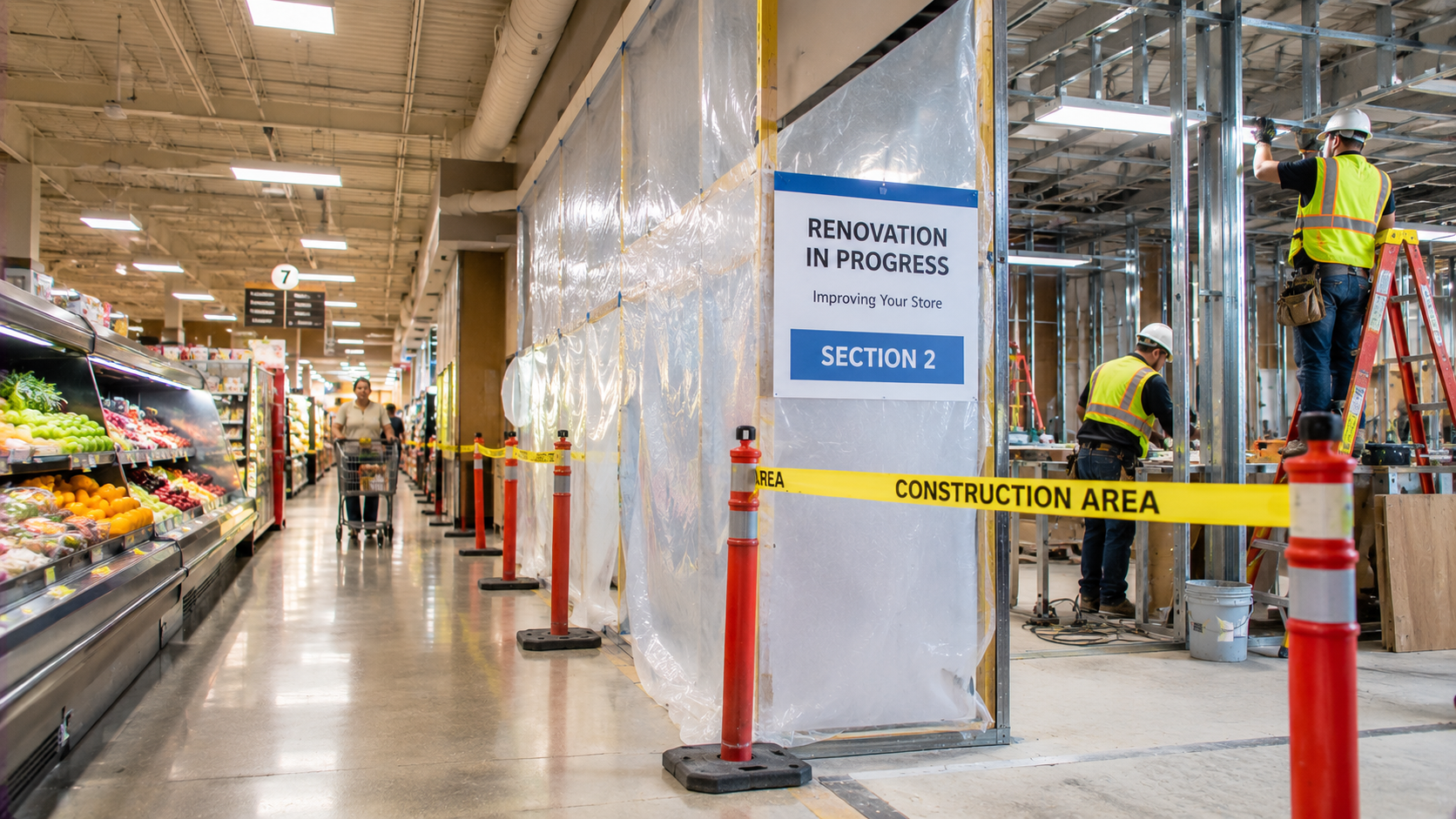
One of the most important responsibilities during live retail construction is maintaining a clear separation between active work areas and customer-accessible spaces.
Construction boundaries should be established before work begins and maintained throughout each phase.
Depending on the project, these controls may include:
-
Temporary partition walls
-
Construction barriers
-
Restricted-access doors
-
Protective floor coverings
-
Temporary directional signage
-
Designated worker entrances
-
Controlled material delivery routes
-
Clearly identified emergency exits
Barriers should be appropriate for the work being performed and should prevent unauthorized access to construction areas.
Customer routes should remain understandable and accessible.
Temporary pathways should not create unnecessary bottlenecks or direct customers into areas where construction activities are taking place.
The project team should regularly inspect barriers and signage, especially when work zones change.
A temporary route that worked during one phase may become unsuitable after construction moves to another section.
5. Coordinate Work Around Store Operating Hours
Construction activities should be scheduled with an understanding of the store’s operating patterns.
Certain tasks may be more practical during low-traffic periods, before opening, or after closing.
Other activities may be completed during regular business hours when the work area is properly separated and the activity does not interfere with store operations.
The contractor should evaluate:
-
Store opening and closing times
-
Customer traffic patterns
-
Delivery and stocking schedules
-
Noise-sensitive activities
-
Utility interruption requirements
-
Equipment movement
-
Material delivery windows
-
Employee access
-
Required inspection appointments
For example, noisy demolition or activities involving significant dust may need to be scheduled outside normal operating hours.
However, not every construction activity requires overnight work. Scheduling should be based on the actual risks, operational requirements, and scope.
A coordinated work calendar helps store management understand when specific activities will take place and what temporary restrictions may be necessary.
Related article: Best Practices for After-Hours Retail Construction.
6. Coordinate Trades Within Each Construction Phase
Phased construction requires careful coordination between multiple trades.
Each zone may involve demolition crews, electricians, plumbers, HVAC contractors, drywall installers, flooring specialists, painters, fixture installers, and other specialty contractors.
The project manager should establish which trades are required in each phase and identify the order in which they must complete their work.
For example, renovating a designated sales floor section may involve:
1. Protecting adjacent customer areas.
2. Removing existing fixtures and finishes.
3. Completing required electrical or mechanical modifications.
4. Performing inspections where required.
5. Installing new finishes.
6. Positioning fixtures and equipment.
7. Completing electrical and technology connections.
8. Performing final verification.
The sequence should account for trade dependencies and avoid bringing contractors into an area before preceding work is complete.
The project team should also limit unnecessary overlap between trades working in restricted spaces.
Clear schedules and regular field coordination help keep each phase moving.
For additional guidance, see Coordinating Trades in Retail Build-Out Projects.
7. Manage Dust, Noise, and Construction Debris
Construction inside an operating store requires additional attention to conditions outside the immediate work area.
Dust, noise, debris, and material movement can affect customers, employees, merchandise, and store operations.
The contractor should establish controls appropriate to the work being performed.
These may include:
-
Dust containment systems
-
Temporary partitions
-
Protective coverings
-
Controlled demolition procedures
-
Regular housekeeping
-
Debris removal schedules
-
Designated waste staging areas
-
Appropriate ventilation controls
-
Noise management procedures
-
Protection of merchandise and equipment
Dust-producing work should be isolated as effectively as practical.
Construction debris should not accumulate in customer pathways, receiving areas, or emergency access routes.
The project team should also coordinate debris removal to prevent carts, equipment, and waste containers from interfering with store activities.
Housekeeping should be treated as an ongoing construction responsibility rather than something reserved for the end of each phase.
Related article: How to Execute Retail Renovations Without Disrupting Operations.
8. Protect Completed Areas During Subsequent Phases
One challenge of phased construction is maintaining the condition of completed areas while work continues elsewhere.
New flooring, fixtures, painted surfaces, equipment, and other installations may be exposed to damage from construction traffic.
The contractor should establish protection requirements before reopening a completed section or moving into an adjacent zone.
Protection measures may include:
-
Temporary floor coverings
-
Corner and wall protection
-
Protective wrapping for fixtures
-
Equipment covers
-
Controlled material routes
-
Restricted access for construction personnel
-
Regular inspections of completed areas
Material staging should also be planned so that supplies for the next phase do not occupy completed customer areas.
Where workers must travel through previously completed sections, designated routes and appropriate protection should be established.
Protecting completed work helps reduce corrective work and prevents later construction activities from compromising earlier phases.
9. Coordinate Utility Interruptions and Building System Work
Some construction activities require temporary interruptions to electrical, plumbing, HVAC, refrigeration, or other building systems.
These interruptions can affect store operations beyond the immediate construction zone.
For example, electrical work in one section may affect equipment or lighting serving another area. A plumbing modification may require temporary restrictions on nearby fixtures or facilities.
Before scheduling an interruption, the contractor should:
1. Identify the affected systems and areas.
2. Determine which store operations may be impacted.
3. Coordinate the proposed interruption with store management.
4. Confirm required approvals and technical procedures.
5. Establish the work schedule.
6. Communicate the expected duration.
7. Verify system restoration after completion.
Work involving electrical systems, fire protection, or other life-safety systems must follow applicable codes, safety procedures, and authorization requirements.
Any required temporary impairment procedures should be coordinated with the appropriate facility representatives and authorities.
Utility interruptions should be planned as part of the construction sequence, not treated as unexpected field activities.
10. Maintain Clear Communication With Store Management
Store management plays an important role in the success of phased construction.
Managers understand the operational impact of construction activities and can help coordinate customer access, employee responsibilities, merchandise movement, and temporary changes to store operations.
The general contractor should establish a communication process before work begins.
Communication should address:
-
Upcoming construction phases
-
Work area restrictions
-
Changes to customer pathways
-
Scheduled utility interruptions
-
Material deliveries
-
Noisy or disruptive activities
-
Safety concerns
-
Construction progress
-
Upcoming transitions
-
Outstanding issues
A designated point of contact helps prevent conflicting instructions and ensures that concerns reach the appropriate project personnel.
Regular coordination meetings or brief field updates can help store management prepare for upcoming work.
Communication should also continue when the construction sequence changes.
For additional guidance, see Communication Strategies for Multi-Location Projects.
11. Establish Clear Phase Completion and Handoff Requirements
A construction zone should not be considered complete simply because the scheduled work has ended.
Before returning an area to normal store use, the project team should verify that the necessary construction, safety, and operational requirements have been addressed.
A phase completion checklist may include:
-
Completion of assigned construction activities
-
Required inspections and approvals
-
Resolution of critical deficiencies
-
Testing of affected equipment and systems
-
Removal of construction debris
-
Cleaning of the completed area
-
Removal or adjustment of temporary barriers
-
Verification of customer access
-
Confirmation that required signage is in place
-
Approval from designated project and store representatives
The handoff should also identify any remaining work that must be completed without affecting the reopened area.
Clear acceptance requirements help prevent unfinished construction from being transferred into the next phase.
They also create a consistent standard for determining when each zone is ready for use.
12. Prepare for Unexpected Conditions and Phase Adjustments
Live retail construction rarely follows a perfectly predictable sequence.
Contractors may discover concealed conditions, damaged infrastructure, unexpected utility locations, or other issues after work begins.
Operational requirements may also change.
For example, a store may experience higher-than-expected customer traffic during a planned construction phase. A material delay may require the project team to adjust the order of work.
A flexible phasing plan should identify how these situations will be managed.
The process should include:
1. Documenting the issue.
2. Identifying affected work areas and construction activities.
3. Assessing operational and safety impacts.
4. Coordinating with affected contractors.
5. Obtaining required approvals.
6. Revising the phase schedule when necessary.
7. Communicating changes to store management.
8. Verifying that revised work conditions remain appropriate.
The goal is to maintain control when adjustments become necessary without compromising safety, quality, or required project approvals.
For related guidance, see Managing Non-Standard Retail Construction Projects.
Common Challenges in Phased Construction for Live Retail Environments
Even well-planned projects can encounter challenges when construction and daily store operations take place simultaneously.
Poorly Defined Construction Zones
Unclear boundaries can create confusion about where customers and employees are allowed to go.
Better approach: Establish clearly marked work zones and customer pathways before mobilization.
Inadequate Construction Sequencing
A trade may be scheduled to work in an area before preceding activities are complete.
Better approach: Build each phase around actual construction dependencies and verify readiness before assigning crews.
Insufficient Protection of Completed Areas
Construction traffic can damage finished floors, fixtures, walls, and equipment.
Better approach: Establish designated travel routes and protection requirements before moving to the next phase.
Poor Coordination With Store Operations
Construction activities may conflict with deliveries, customer traffic, stocking, or employee responsibilities.
Better approach: Coordinate the construction calendar with store management and communicate upcoming restrictions.
Unplanned Utility Interruptions
Unexpected service interruptions can affect equipment and areas beyond the construction zone.
Better approach: Identify affected systems and coordinate approved interruptions before work begins.
Excessive Noise and Dust
Construction conditions may affect customer comfort and merchandise protection.
Better approach: Use appropriate containment, housekeeping, ventilation, and work-hour controls.
Incomplete Phase Handoffs
An area may be reopened before required work, testing, or corrective actions are completed.
Better approach: Use documented phase completion and acceptance checklists.
Changes to the Construction Sequence
Unexpected conditions or operational changes may make the original phasing plan impractical.
Better approach: Establish a documented process for evaluating and communicating phase adjustments.
How to Measure Phased Construction Performance
Phased construction should be evaluated through both construction performance and operational considerations.
Useful performance indicators include:
| Performance Indicator | What It Measures |
| Phase schedule adherence | Whether each construction phase finishes within its planned duration |
| Zone readiness | Whether work areas are ready before the next phase begins |
| Customer access continuity | Whether planned customer routes remain available |
| Trade remobilization | Additional contractor visits caused by incomplete work or poor sequencing |
| Rework frequency | Corrective work caused by construction or coordination issues |
| Utility interruption duration | Time required to complete planned service interruptions |
| Phase handoff completion | Percentage of zones meeting established completion requirements |
| Safety observations | Identification and resolution of construction-related hazards |
| Deficiency resolution time | Time required to address issues identified during phase inspections |
| Overall schedule variance | Difference between the planned and actual project completion dates |
Retailers may also monitor operational indicators such as customer complaints, access restrictions, or disruptions to important store activities.
These measurements help determine whether the phasing strategy is working as intended.
For example, frequent delays during zone transitions may indicate that the contractor needs to improve readiness verification or trade sequencing.
Repeated damage to completed areas may point to insufficient protection or poorly planned material routes.
Tracking performance across projects can help refine future construction strategies.
What to Look for in a General Contractor for Phased Retail Construction
Retailers planning renovations in operating stores should evaluate whether their general contractor has the experience and project controls needed to manage construction without unnecessarily interfering with daily operations.
Important capabilities include:
Operational planning: Can the contractor assess store activities and identify areas that must remain accessible?
Construction phasing: Can the team develop practical work zones and a logical construction sequence?
Trade coordination: Can the contractor align subcontractor activities within each phase?
Safety management: Are construction boundaries, customer pathways, and temporary access arrangements properly managed?
Schedule control: Does the contractor monitor phase durations and coordinate transitions?
Utility coordination: Can the team plan service interruptions and restoration activities?
Quality assurance: Are completed zones inspected before being returned to normal use?
Communication: Does the contractor maintain consistent coordination with store management and other stakeholders?
Change management: Can the team adjust the phasing strategy when unexpected conditions arise?
Multi-location experience: Can the contractor apply consistent construction procedures across multiple retail locations?
A capable general contractor should understand that construction progress and store operations must be managed together.
How Prime Retail Services Supports Phased Retail Construction
Prime Retail Services is a nationwide commercial general contractor supporting construction, renovation, and multi-location programs across retail and other commercial environments.
Construction inside operating stores requires careful planning, coordinated trade activities, and ongoing communication with store personnel.
Our approach emphasizes structured project management, controlled execution, and repeatable procedures that help align construction activities with client operational requirements.
Our capabilities include:
-
Remodels and Renovations: Coordinated construction activities within existing commercial facilities.
-
Build-Outs and Store Refreshes: Execution of commercial improvements and interior modifications.
-
Special Project Rollouts: Coordinated execution for time-sensitive construction requirements.
-
Multi-Site FF&E Programs: Management of fixture, furniture, and equipment installations across multiple locations.
-
Electrical Coordination: Additional project capabilities through Prime Power Solutions.
-
Technology Deployment: Technology installation and infrastructure support through Prime-Net.
Through our proprietary 3P Process, Perfect, Project, Process, we emphasize execution quality, project coordination, and repeatable procedures that support consistent project delivery.
With general contracting licenses in 49 states, excluding Hawaii, Prime Retail Services supports commercial construction requirements across a broad geographic footprint.
Our focus is to help clients coordinate construction resources, manage site-specific requirements, and maintain project visibility throughout commercial construction programs.
Frequently Asked Questions
What is phased construction in retail?
Phased construction divides a larger retail construction or renovation project into smaller work areas or stages. This allows construction to proceed in a planned sequence while portions of the store remain operational.
Why do retailers use phased construction?
Retailers may use phased construction to reduce operational disruption, maintain customer access, preserve portions of the sales floor, and complete improvements without closing the entire location.
How do contractors determine construction phases?
Contractors evaluate the store layout, project scope, construction dependencies, customer circulation, safety requirements, utility systems, and operational priorities before developing the sequence.
Can stores remain open during phased construction?
Yes, when the project scope and site conditions allow it. The contractor must establish appropriate construction boundaries, maintain required access, and coordinate activities with store management.
How can contractors minimize customer disruption?
They can use clearly defined work zones, temporary barriers, directional signage, coordinated work schedules, housekeeping controls, and regular communication with store personnel.
Should all construction work take place after store hours?
Not necessarily. Some activities can take place during normal operating hours when properly isolated. Other activities may need to be scheduled during low-traffic periods or outside normal business hours.
How many phases should a retail construction project have?
There is no universal number. The appropriate number depends on the size of the store, construction scope, operational requirements, available work areas, and the sequence of trade activities.
How do contractors protect completed areas during later phases?
They can use protective floor coverings, fixture protection, controlled material routes, designated worker access, and regular inspections of completed work.
What happens if unexpected conditions affect the phasing plan?
The contractor should assess the issue, evaluate its impact on construction and store operations, coordinate affected trades, obtain necessary approvals, and communicate any revised sequence.
How can retailers evaluate a contractor’s phased construction capabilities?
Retailers should review the contractor’s experience in occupied facilities, phasing methodology, trade coordination, safety procedures, operational communication, quality controls, and multi-location project management.
Final Thoughts
Phased construction provides retailers with a practical approach to completing improvements while maintaining portions of their stores for normal business activities.
However, successful execution requires more than dividing a project into smaller sections. Every phase must account for construction dependencies, customer circulation, safety controls, trade coordination, utility requirements, and operational priorities.
The most effective approach begins with a thorough understanding of store operations and continues through carefully planned work zones, coordinated schedules, documented handoffs, and consistent field oversight.
A general contractor must be able to manage construction activities while recognizing that the store remains an active business environment.
Ultimately, a successful phased construction strategy allows retailers to move forward with improvements while maintaining a controlled, safe, and functional environment for customers and employees.
Planning a renovation or construction project in an operating retail location?
Contact Prime Retail Services at info@primeretailservices.com to discuss your next commercial construction project.