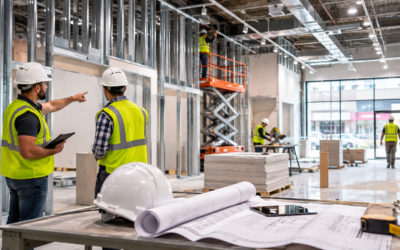
Retail remodels are essential for maintaining modern, functional, and competitive store environments. Whether a retailer is updating fixtures, replacing flooring, refreshing departments, or completing a larger interior renovation, the construction approach can have a significant impact on business operations.
One of the most important decisions is whether to keep the store open during construction or temporarily close the facility until the work is complete.
Both approaches have advantages and limitations.
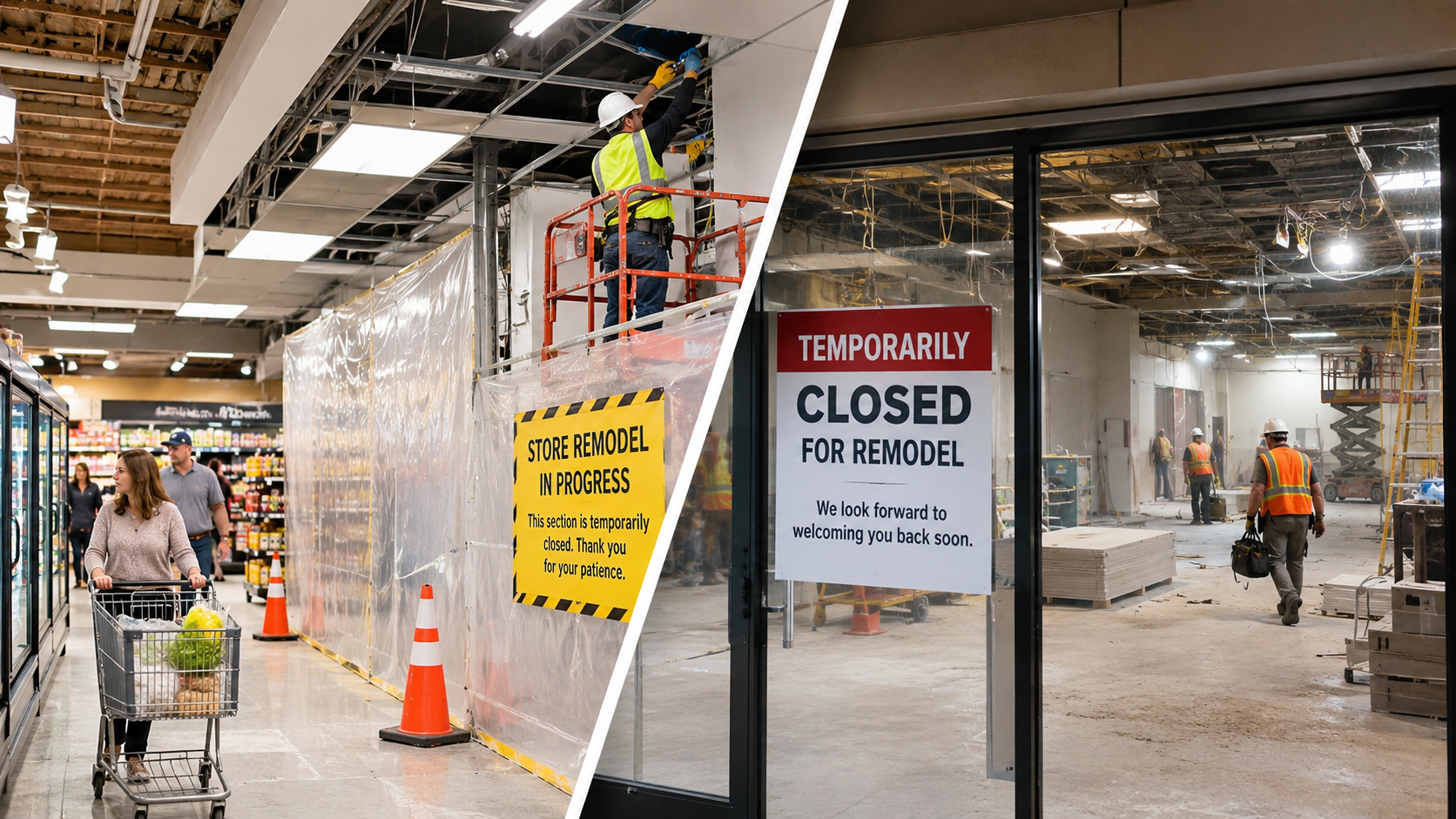
Phased retail remodels allow construction to proceed in sections while the store continues serving customers. Full closures provide contractors with greater access to the facility, potentially allowing more efficient execution of extensive or disruptive work.
The right approach depends on the project scope, construction schedule, customer traffic, safety requirements, operational priorities, and the retailer’s ability to accommodate temporary disruptions.
Understanding the differences between these two strategies helps retailers make informed decisions before construction begins.
What Is a Phased Retail Remodel?
A phased retail remodel is a construction approach in which renovation activities are divided into smaller sections or stages.
Instead of closing the entire store, the contractor completes work in designated areas while other portions of the facility remain operational.
For example, a retailer renovating a large store may divide the project into several phases:
1. Renovate one department or section.
2. Complete inspections and cleanup.
3. Reopen the completed area.
4. Move construction activities to another section.
5. Repeat the process until the entire project is complete.
This approach allows retailers to maintain some level of business activity throughout construction.
Phased remodels are commonly considered for:
-
Department renovations
-
Flooring replacements
-
Fixture and shelving upgrades
-
Checkout counter modifications
-
Lighting improvements
-
Store refresh programs
-
Interior finish replacements
-
Selected electrical and technology upgrades
The specific sequence depends on the facility layout, construction requirements, and operational constraints.
For additional guidance, see our article on retail construction in open stores.
What Is a Full Store Closure During a Remodel?
A full closure means temporarily suspending normal store operations so construction teams can access the facility and complete the planned renovation work.
Depending on the project, the closure may last several days, several weeks, or longer.
Unlike phased construction, a full closure generally allows contractors to work across larger portions of the facility without maintaining normal customer access.
This can be beneficial for projects involving extensive demolition, major layout changes, significant infrastructure upgrades, or multiple construction activities that would be difficult to coordinate around customers.
Full closures may be appropriate for:
-
Extensive interior renovations
-
Major flooring replacement programs
-
Large-scale fixture and millwork installations
-
Significant electrical or mechanical upgrades
-
Major department reconfigurations
-
Extensive ceiling and lighting replacements
-
Construction involving substantial demolition
-
Projects requiring broad access to the facility
Although closing the store creates an opportunity for more direct construction access, it also introduces business considerations involving lost sales, employee scheduling, inventory, customer communication, and reopening requirements.
Phased Retail Remodels vs. Full Closures: Key Differences
Both approaches can support successful retail renovations, but they differ in how construction activities are organized and how the store operates during the project.
| Consideration | Phased Retail Remodel | Full Store Closure |
| Store operations | Continues in unaffected areas | Temporarily suspended |
| Customer access | Maintained through designated pathways | Generally unavailable |
| Construction access | Limited to designated work areas | Broader access throughout the facility |
| Scheduling | Requires coordination around store operations | Allows more flexible construction sequencing |
| Safety management | Requires separation between customers and construction | Focuses on securing the closed facility |
| Construction productivity | May be affected by operational restrictions | May improve for certain disruptive activities |
| Customer experience | Potential inconvenience during construction | Temporary loss of access to the store |
| Business continuity | Helps maintain some ongoing sales activity | Requires temporary operational adjustments |
| Project complexity | Often requires detailed phasing and access planning | May simplify certain construction activities |
| Best suited for | Work that can be separated into manageable sections | Extensive or highly disruptive renovations |
Neither approach is automatically more cost-effective or faster. The actual outcome depends on project conditions and how effectively the work is planned.
Advantages of Phased Retail Remodels
Keeping a store operational during renovation can provide important business benefits, particularly when the project involves areas that can be isolated from the rest of the facility.
1. Maintains Business Operations
One of the primary advantages of phased construction is the ability to continue serving customers during renovation.
Although certain departments or sections may be temporarily restricted, the rest of the store can remain available.
This can help retailers maintain sales activity, customer relationships, and employee operations while improvements are underway.
For businesses that depend on consistent daily traffic, maintaining partial operations may be an important consideration.
2. Reduces the Need for a Complete Shutdown
A full store closure can create significant operational challenges.
Retailers may need to coordinate temporary closures, adjust employee schedules, relocate inventory, communicate with customers, and manage the financial impact of suspended operations.
Phased construction may reduce the need for these arrangements by allowing the store to remain partially accessible.
3. Allows Construction to Be Completed in Manageable Sections
Dividing a project into phases can make large renovations easier to coordinate.
The contractor can focus on designated work areas, complete the required activities, and move to the next section as conditions allow.
This approach can also help identify potential issues early, allowing the project team to adjust subsequent phases when necessary.
4. Supports Ongoing Customer Access
Retailers can maintain access to essential departments, checkout areas, and services while construction takes place elsewhere.
This requires clear signage, temporary pathways, protective barriers, and coordination with store management.
When properly executed, phased remodels can help preserve a functional shopping environment throughout the project.
5. Provides Opportunities for Operational Feedback
Because the store remains active, employees and management can provide feedback on how construction arrangements affect daily operations.
This information can help the project team improve communication, access planning, and sequencing during later phases.
Challenges of Phased Retail Remodels
Although phased remodels can help maintain business continuity, they introduce additional construction and coordination requirements.
1. Limited Work Areas
Construction crews may have access to only a portion of the facility at any given time.
This can restrict material staging, equipment movement, and the number of workers who can operate efficiently within the designated area.
2. More Complex Scheduling
Construction activities must be coordinated around customer traffic, employee workflows, deliveries, and store operating hours.
Certain tasks may need to be completed overnight or during approved low-traffic periods.
3. Additional Safety Controls
Maintaining an active store requires clear separation between customers and construction activities.
Temporary barriers, controlled access points, directional signage, and housekeeping procedures must be maintained throughout the project.
4. Potentially Longer Overall Construction Duration
Phased execution may extend the overall project timeline because activities cannot always proceed simultaneously.
For example, a contractor may need to complete one section before moving materials and crews into the next.
However, a longer construction period does not necessarily mean higher total project costs. The impact depends on labor efficiency, site restrictions, scheduling, and the financial implications of keeping the store operational.
5. Ongoing Customer Disruption
Even with appropriate precautions, customers may experience temporary changes to their shopping environment.
Noise, restricted aisles, relocated merchandise, and construction activity can affect the customer experience.
Our article on Minimizing Customer Impact During Active Store Projects discusses strategies for managing these conditions.
Advantages of Full Store Closures
A full closure may be the more practical approach when the project involves extensive work that cannot be easily separated from normal store operations.
1. Greater Construction Access
Contractors can generally access a larger portion of the facility without having to maintain customer pathways through active work areas.
This can simplify material movement, equipment access, demolition, and installation activities.
2. More Flexible Construction Scheduling
Without normal customer operations, the project team may have greater flexibility in organizing work schedules.
Multiple trades may be able to work in different areas simultaneously, provided their activities are properly coordinated and safe.
This can create opportunities to complete certain construction activities more efficiently.
3. Better Conditions for Extensive Renovations
Some projects involve work that affects most or all of the facility.
For example, replacing flooring throughout a store, modifying major building systems, or completing extensive demolition may be difficult to perform while customers are present.
A full closure can provide a more controlled environment for these activities.
4. Fewer Customer-Facing Construction Restrictions
Because customers are not entering the facility during the renovation, contractors do not need to maintain the same level of customer access and separation within the work area.
However, site security, worker safety, emergency access, and construction controls remain essential.
5. Opportunities for Coordinated Trade Execution
A full closure may allow several related activities to be coordinated within a concentrated construction window.
For example, flooring, ceiling, lighting, fixture installation, and finish work may be sequenced across multiple areas without having to reopen sections between every activity.
This depends on the actual construction scope and the readiness of materials, labor, and preceding work.
Challenges of Full Store Closures
Closing a store can simplify certain construction activities, but it also creates business and project management challenges.
1. Temporary Loss of Sales
A full closure means customers cannot shop at the location during the renovation.
For retailers, the financial impact of lost sales may be one of the most important factors in deciding whether to close.
2. Employee and Inventory Coordination
Store management may need to arrange temporary staffing changes, inventory relocation, equipment protection, and other operational adjustments.
These activities require coordination before construction begins.
3. Reopening Deadlines Become Critical
Retailers may establish a specific reopening date based on business commitments, seasonal demand, promotional schedules, or customer expectations.
Missing that date can create significant operational and financial consequences.
4. Greater Pressure on the Construction Schedule
When the store is closed specifically to complete renovations, every additional day may affect the retailer’s operating plans.
The construction team must carefully coordinate procurement, labor, inspections, testing, and closeout to support the target reopening date.
5. Construction Delays Can Affect the Entire Business
Unexpected site conditions, material shortages, failed inspections, or unresolved scope changes may delay reopening.
Without adequate contingency planning, a relatively small construction issue can have a broader operational impact.
For guidance on managing demanding timelines, see Planning for Compressed Construction Schedules.
When Does a Phased Retail Remodel Make More Sense?
A phased approach is generally worth considering when construction activities can be separated into manageable areas without compromising safety or creating unacceptable operational disruption.
It may be appropriate when:
-
Only selected departments require renovation.
-
Customer pathways can be maintained safely.
-
Essential store functions can remain accessible.
-
Construction activities can be isolated with appropriate barriers.
-
The project can be divided into logical phases.
-
Materials and equipment can be delivered without disrupting operations.
-
The retailer wants to maintain some level of business activity.
For example, a store replacing shelving and updating merchandise displays may be able to complete the work department by department.
Similarly, a flooring project may be divided into sections if the floor system, access arrangements, and construction schedule allow safe transitions between completed and active areas.
The project team should evaluate whether the benefits of maintaining store operations outweigh the additional coordination and scheduling requirements.
When Is a Full Store Closure the Better Option?
A full closure may be more practical when the scope of work affects a substantial portion of the facility or when maintaining customer access would create unacceptable safety, operational, or construction constraints.
It may be appropriate when:
-
Extensive demolition is required.
-
Major building systems need modification.
-
Flooring replacement affects most of the store.
-
The layout is being substantially reconfigured.
-
Multiple construction trades require unrestricted access.
-
Work cannot be safely separated from customer areas.
-
Required utility interruptions would affect essential operations.
-
The project cannot be completed effectively within available operating hours.
For example, a major store renovation involving demolition, new electrical distribution, extensive ceiling work, and complete fixture replacement may be better suited to a full closure.
The decision should be based on an evaluation of the complete project scope rather than the assumption that closing the store will automatically make construction faster.
8 Factors to Consider Before Choosing a Construction Approach
Before deciding between a phased remodel and a full closure, retailers and contractors should evaluate the following factors.
1. Project Scope and Complexity
The first consideration is the amount and type of work involved.
A limited fixture replacement may be relatively easy to phase. A complete interior renovation involving multiple building systems may require broader access.
The team should identify which activities can be separated and which depend on completing other work first.
2. Store Size and Layout
The physical layout can determine whether construction areas can be isolated effectively.
Larger facilities may offer more opportunities to divide work into separate zones. Smaller stores may have limited space for temporary pathways, material staging, and customer circulation.
3. Customer Traffic and Sales Volume
High-volume stores may experience greater operational impact when customer access is restricted.
Retailers should evaluate peak shopping periods, seasonal demand, promotional events, and the availability of nearby locations.
4. Safety and Accessibility
Customer and employee safety must remain a priority.
If construction activities cannot be adequately separated from occupied areas, a full closure or more restrictive work arrangement may be necessary.
Emergency egress, accessible routes, and applicable building and safety requirements must be considered.
5. Material and Equipment Requirements
Large fixtures, specialized equipment, and bulk material deliveries may require more space and access than an active store can provide.
The project team should evaluate unloading areas, staging capacity, installation requirements, and material protection.
6. Trade Availability and Construction Sequencing
The ability to coordinate subcontractors and schedule activities affects the practicality of either approach.
Phased construction may require repeated mobilization and carefully coordinated work windows. A full closure may allow more activities to overlap, provided the work areas and dependencies permit it.
7. Budget and Business Impact
The decision should account for both construction costs and the operational consequences of closing or restricting the store.
Relevant considerations include:
-
Lost sales during closure
-
Temporary operating arrangements
-
Additional labor and mobilization
-
Extended project duration
-
Temporary barriers and protection
-
Material handling and storage
-
After-hours labor requirements
-
Potential schedule recovery costs
The lowest construction bid does not necessarily represent the lowest overall business impact.
8. Required Completion Date
A fixed reopening date or seasonal deadline may influence the construction strategy.
The team should determine whether the required schedule is achievable through phased work or whether a concentrated closure period offers a more practical path.
A realistic schedule must account for procurement, permitting, inspections, testing, and final turnover.
Can a Hybrid Approach Work?
Yes. Some retail projects benefit from combining phased construction with temporary closures or restricted operating periods.
A hybrid approach allows the contractor to maintain operations during certain phases while reserving more disruptive activities for scheduled closure windows.
For example, a retailer may:
1. Complete preliminary fixture removals in selected departments while the store remains open.
2. Perform limited electrical and infrastructure work during approved off-hours.
3. Temporarily close the facility for major flooring replacement.
4. Reopen completed areas after inspections and cleanup.
5. Complete final installations and adjustments through controlled work zones.
This approach can provide greater flexibility when the project contains both operationally manageable and highly disruptive activities.
However, hybrid execution requires careful coordination. The project team must establish clear boundaries between operating periods, restricted work periods, and full closure windows.
How to Plan a Phased Retail Remodel
When a phased approach is selected, the project team should establish a detailed execution plan before mobilization.
Step 1: Assess the Facility
Review existing conditions, store layout, customer traffic, construction requirements, and operational constraints.
Identify areas that can be renovated independently and determine which functions must remain available.
Step 2: Divide the Project Into Logical Phases
Create construction zones based on the scope, trade dependencies, and available access.
Each phase should have defined work boundaries, completion requirements, and reopening criteria.
Step 3: Establish Customer and Employee Access Plans
Coordinate temporary pathways, signage, barriers, emergency access, and accessible routes with store management.
Ensure that customers and employees are not directed through active construction areas.
Step 4: Coordinate Trades and Materials
Confirm subcontractor availability, delivery schedules, equipment requirements, and material staging arrangements.
The sequence should minimize unnecessary movement between work areas.
Step 5: Set Clear Work Windows
Determine which activities can occur during normal operating hours and which should be scheduled after hours or during temporary closures.
Step 6: Monitor Progress and Adjust as Needed
Review completed work, upcoming activities, site conditions, and outstanding issues regularly.
If a phase falls behind schedule, evaluate whether subsequent activities can be resequenced without compromising safety or quality.
Step 7: Inspect and Prepare Each Area for Reopening
Before returning an area to normal use, verify that the work is complete, debris has been removed, hazards have been addressed, and required inspections have been completed.
For more guidance, see How to Execute Retail Renovations Without Disrupting Operations.
How to Plan a Full Store Closure for Renovation
A full closure also requires extensive preparation. Removing customer activity does not eliminate the need for careful construction planning.
Step 1: Define the Complete Construction Scope
Confirm drawings, specifications, equipment requirements, material selections, and project responsibilities before the closure begins.
Step 2: Complete Preconstruction Coordination
Resolve permitting, approvals, subcontractor assignments, procurement, and major schedule dependencies.
Step 3: Confirm the Closure and Reopening Dates
Establish the approved construction window and identify the milestones required to reopen the store.
Step 4: Prepare the Facility
Coordinate inventory removal or protection, equipment shutdowns, access arrangements, security, and designated construction areas.
Step 5: Sequence All Construction Activities
Develop a detailed schedule that coordinates demolition, electrical, mechanical, flooring, fixture installation, finishes, testing, and inspections.
Step 6: Monitor Critical Activities
Track materials, labor, inspections, and schedule performance closely. Identify potential delays before they affect the reopening date.
Step 7: Complete Final Verification
Inspect the completed work, resolve deficiencies, confirm required approvals, and coordinate the return of store equipment and operations.
How General Contractors Help Determine the Best Approach
The decision between a phased remodel and a full closure should involve both the retailer and the general contractor.
The contractor evaluates construction requirements, while the retailer provides essential information about sales operations, staffing, customer traffic, inventory, and business priorities.
An experienced commercial general contractor should help assess:
-
The feasibility of maintaining store operations
-
The ability to isolate construction activities
-
Site access and material handling requirements
-
Trade coordination and scheduling
-
Safety and accessibility considerations
-
Procurement and labor availability
-
Project cost and schedule implications
-
Reopening and turnover requirements
The contractor should also identify risks associated with each option rather than recommending an approach based only on construction convenience.
Effective project management is particularly important when multiple trades, operational stakeholders, and schedule constraints are involved. Learn more in Why Project Management Matters in Retail Construction.
How to Measure the Success of a Retail Remodel
Regardless of whether a retailer chooses phased construction or a full closure, project performance should be measured against established objectives.
| Performance Indicator | What It Measures |
| Schedule adherence | Whether construction milestones are completed as planned |
| Budget performance | Actual construction costs compared with the approved budget |
| Operational disruption | Impact on store operations during construction |
| Customer access | Availability of safe and accessible customer pathways |
| Safety performance | Incidents involving workers, employees, or customers |
| Rework frequency | Additional work required to correct deficiencies |
| First-pass quality | Work accepted without corrective action |
| Reopening readiness | Whether the facility or completed area is ready for use as scheduled |
| Closeout completion | Timely completion of documentation and final acceptance |
These indicators help retailers evaluate not only construction performance but also how effectively the selected approach supports business operations.
How Prime Retail Services Supports Retail Remodels and Renovations
Prime Retail Services is a nationwide commercial general contractor supporting construction, renovation, and multi-location programs across retail and other commercial environments.
Our approach emphasizes coordinated planning, centralized project oversight, and disciplined field execution.
Whether a project involves a phased renovation, a temporary store closure, or a larger multi-location program, the construction strategy must account for the facility’s existing conditions, operational requirements, and project objectives.
Our capabilities include:
-
Remodels and Renovations: Coordinated construction activities within existing commercial facilities.
-
Build-Outs and Refreshes: Planned execution of interior improvements, fixture installations, and space updates.
-
Special Project Rollouts: Coordinated deployment for time-sensitive construction requirements.
-
Multi-Site FF&E Programs: Management of fixture, furniture, and equipment installations across multiple locations.
-
Electrical Coordination: Additional project capabilities through Prime Power Solutions.
-
Technology Deployment: Technology installation and infrastructure support through Prime-Net.
Through our proprietary 3P Process, Perfect, Project, Process, we emphasize execution quality, project coordination, and repeatable procedures that support consistent project delivery.
With general contracting licenses in 49 states, excluding Hawaii, Prime Retail Services supports commercial construction requirements across a broad geographic footprint.
Our focus is to help clients evaluate project requirements, coordinate construction activities, and execute renovations with the planning and oversight needed to support their business objectives.
Frequently Asked Questions
Is it better to remodel a retail store while it remains open?
It depends on the project scope and operational requirements. Phased remodeling may be appropriate when work can be separated into manageable areas and customer access can be maintained safely. More extensive renovations may require a temporary full closure.
Are phased retail remodels more expensive than full closures?
Not necessarily. Phased construction may involve additional coordination, repeated mobilization, temporary barriers, and restricted work windows. Full closures may allow more efficient execution of certain activities but can introduce lost sales and other business costs. The total impact depends on the project.
Does a full store closure make construction faster?
It can provide greater access and scheduling flexibility, but it does not automatically shorten the project. Material availability, permitting, labor, site conditions, and construction sequencing still determine the schedule.
Can a retail store remain open during flooring replacement?
In some cases, yes. The project may be divided into sections with appropriate barriers and temporary pathways. However, the flooring system, installation method, curing requirements, and safety conditions must be evaluated before determining whether phased work is practical.
When should a retailer consider closing a store for renovation?
A closure may be appropriate when extensive demolition, major infrastructure modifications, substantial layout changes, or other disruptive activities cannot be safely or efficiently separated from normal store operations.
Can contractors perform retail renovations overnight?
Yes, when approved by the client and appropriate for the project. After-hours construction can reduce customer disruption and provide additional flexibility for certain activities. It still requires careful scheduling, site access coordination, safety controls, and cleanup.
What is a hybrid retail remodel?
A hybrid remodel combines phased construction with selected closure periods. It allows certain work to take place while the store remains open, while more disruptive activities are scheduled during temporary closures or restricted operating windows.
How can retailers minimize customer disruption during phased construction?
Common strategies include clearly defined construction zones, temporary barriers, directional signage, safe customer pathways, dust containment, after-hours scheduling, and regular coordination with store management.
Who decides whether a store should remain open during renovation?
The decision should be made collaboratively by the retailer and general contractor. The retailer evaluates business and operational priorities, while the contractor assesses construction feasibility, safety, scheduling, and site conditions.
Final Thoughts
Choosing between a phased retail remodel and a full store closure requires balancing construction requirements with business priorities.
Phased construction can help retailers maintain operations and customer access, but it demands careful scheduling, trade coordination, and site controls. Full closures can provide greater construction access and flexibility, but they introduce operational challenges and make reopening deadlines especially important.
Neither approach is universally better.
The most effective strategy is the one that aligns the construction scope, schedule, safety requirements, and operational objectives of the retailer.
With proper planning and coordinated project management, retailers can make informed decisions that support successful renovations while protecting the long-term performance of their stores.
Planning a retail remodel or renovation?
Contact Prime Retail Services at info@primeretailservices.com to discuss your next commercial construction project.