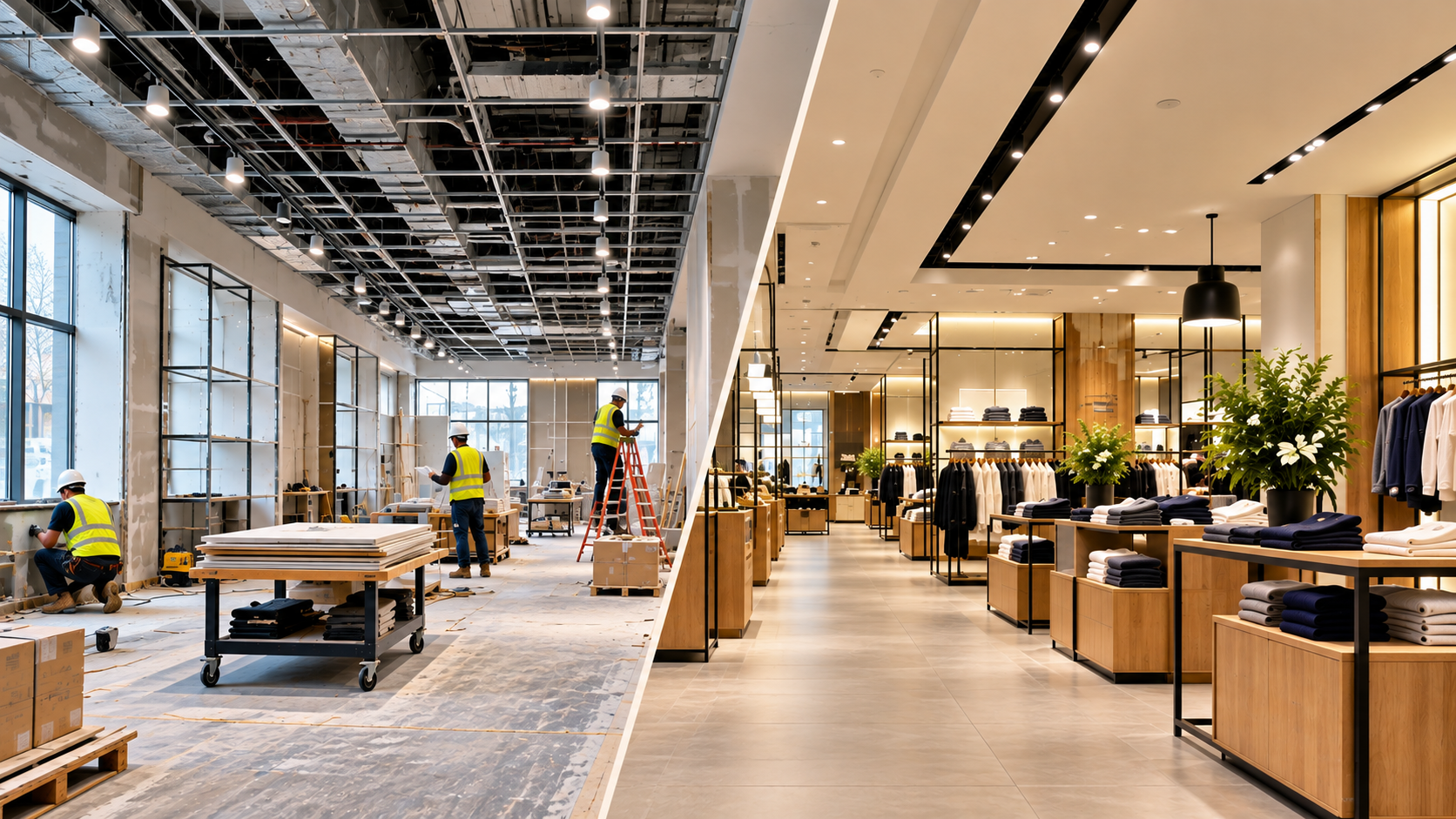
Retail refresh programs help brands modernize their physical locations, improve the customer experience, and keep stores aligned with evolving brand standards. But when a refresh involves dozens or hundreds of locations, maintaining consistency becomes a significant construction and project management challenge.
A store refresh is not simply about updating finishes, replacing fixtures, or introducing a new color palette. It is about ensuring that every location reflects the same brand identity while accounting for differences in existing store conditions, local building requirements, construction schedules, and operational needs.
The most effective way to maintain brand consistency during a retail refresh program is to establish clear brand standards, standardize scopes of work, assess every location before construction, coordinate execution through centralized program management, and verify quality against consistent acceptance criteria. Controlled flexibility is equally important because individual stores may require different construction solutions to achieve the same brand outcome.
For retailers managing regional or nationwide refresh programs, an experienced general contractor can help translate brand guidelines into repeatable construction processes, coordinate local execution, and maintain visibility across the entire portfolio.
As a nationwide commercial general contractor, Prime Retail Services supports retail construction initiatives that require coordinated execution across multiple locations. Understanding the principles below can help retailers build a more consistent, predictable, and scalable approach to store refresh programs.
What Is Brand Consistency in Retail Refresh Programs?
Brand consistency in retail refresh programs means ensuring that every updated store reflects the same approved visual identity, customer experience, functional standards, and quality expectations, regardless of location.
This includes more than matching paint colors or installing identical signage. It involves coordinating the physical elements that customers see and interact with, as well as the construction processes required to deliver those elements consistently.
Key components of retail brand consistency include:
- Visual identity: Consistent colors, finishes, signage, lighting, graphics, and branded architectural elements.
- Store layout: Consistent customer pathways, merchandise presentation, service areas, and fixture placement.
- Materials and finishes: Approved flooring, wall treatments, millwork, hardware, and other finish materials.
- Fixtures and equipment: Consistent installation, positioning, and alignment with approved plans.
- Customer experience: A recognizable and familiar shopping environment across the entire store network.
- Construction quality: Repeatable workmanship, documented inspections, and consistent completion standards.
For a retailer operating across multiple states, these elements must remain consistent even when individual locations have different floor plans, existing conditions, building systems, or landlord requirements.
The objective is not necessarily to make every store physically identical. It is to make every store feel unmistakably part of the same brand.
Why Brand Consistency Matters During Multi-Location Retail Refreshes
A retail refresh represents a direct investment in the physical expression of a brand. When that investment is implemented across multiple locations, inconsistencies can undermine the intended result.
A well-coordinated refresh program helps protect that investment in several ways.
1. It Protects Brand Recognition
Customers develop familiarity with a brand through repeated experiences. Store layouts, visual merchandising, signage, lighting, and finishes all contribute to that recognition.
If one refreshed location features different finishes, incorrectly positioned graphics, or inconsistent fixture arrangements, the customer experience may feel disconnected from other stores in the network.
Standardized construction documents and quality checks help ensure that approved brand elements are implemented consistently.
2. It Creates a More Predictable Customer Experience
Customers should not have to relearn how to navigate a store every time they visit another location.
Consistent layouts, signage, service areas, and merchandise presentation help create a familiar shopping experience. This is particularly important for retailers with frequent customers who visit stores in different markets.
3. It Protects the Return on the Refresh Investment
Retail refreshes require investment in design, materials, labor, fixtures, logistics, and construction management.
When work must be corrected because specifications were misunderstood or installation quality varied, the program may incur additional labor, material replacement, and schedule disruption.
Clear standards and consistent inspections help reduce avoidable rework and protect the value of the original investment.
4. It Supports Faster Execution Across Locations
Once a retailer establishes a repeatable process, subsequent locations can benefit from lessons learned during earlier phases.
Teams can reuse approved scopes, clarify recurring construction details, improve scheduling assumptions, and resolve common issues before they affect additional stores.
This creates a more efficient model for future retail refreshes and nationwide rollout programs.
5. It Strengthens Long-Term Brand Management
Brand standards evolve as companies update their positioning, visual identity, merchandise strategies, and customer experience.
A structured refresh program gives retailers a controlled way to implement those changes across their physical locations while maintaining alignment between corporate expectations and field execution.
The result is a more manageable process for keeping a growing store network current and consistent.
8 Essential Steps to Maintain Brand Consistency During Retail Refresh Programs
1. Establish a Centralized Retail Brand Standards Manual
Every successful retail refresh program starts with a single, approved source of truth.
A brand standards manual translates the retailer’s visual identity and store design requirements into instructions that designers, general contractors, subcontractors, fixture installers, and field teams can follow.
Without clear documentation, individual teams may interpret design intent differently. Those differences can become visible across locations, particularly when construction is managed by multiple regional teams.
A comprehensive retail brand standards manual should include:
-
Approved color palettes, paint codes, and finish schedules
-
Flooring, wall treatments, ceiling finishes, and material specifications
-
Signage dimensions, placement, mounting methods, and illumination requirements
-
Fixture types, dimensions, installation details, and positioning
-
Millwork specifications and branded architectural features
-
Lighting requirements and approved fixture selections
-
Hardware, accessories, and other customer-facing details
-
Accessibility, life safety, and applicable building code considerations
-
Approved alternatives for discontinued or unavailable materials
-
Photography, inspection, and final acceptance requirements
The manual should also distinguish between mandatory brand requirements and elements that may be adjusted to accommodate site conditions.
For example, a specific wall finish may be mandatory across every store, while the method of installing that finish may vary depending on the existing substrate.
This distinction helps teams preserve the intended visual result without forcing identical construction methods onto fundamentally different spaces.
Practical recommendation: Maintain a controlled digital library of approved drawings, finish schedules, specifications, and installation details. Assign document owners and revision dates so field teams do not unknowingly work from outdated plans.
2. Conduct Site Assessments Before Finalizing Construction Scopes
A standardized design does not eliminate the need to evaluate each location.
Existing retail stores can differ considerably in age, layout, infrastructure, ceiling conditions, previous renovations, and landlord requirements. These differences can affect how the approved refresh design is implemented.
A site assessment identifies those conditions before they create construction delays or compromise brand standards.
A thorough retail refresh site assessment should examine:
-
Existing floor plans and field dimensions
-
Current finishes and their condition
-
Wall, ceiling, and flooring conditions
-
Existing fixtures and their compatibility with the new design
-
Electrical capacity, lighting, and equipment requirements
-
Low-voltage infrastructure and technology requirements
-
Accessibility and life safety considerations
-
Potential hazardous materials requiring appropriate evaluation
-
Landlord restrictions and building operating requirements
-
Site access, material storage, and construction scheduling constraints
The findings should be documented through standardized checklists, measurements, photographs, and notes.
This information allows the project team to distinguish between locations that can follow the standard scope and those that require approved modifications.
For example, two stores may receive the same new branded wall treatment. One location may have a suitable existing substrate, while another requires additional preparation or repairs. Identifying that difference early helps protect both the finish quality and the construction budget.
For multi-site programs, consistent site documentation also makes it easier to compare locations and identify recurring issues before they affect additional stores.
3. Standardize Scopes of Work While Allowing Controlled Flexibility
A consistent brand experience requires consistent construction instructions.
When scopes of work vary unnecessarily between locations, contractors may interpret the same design differently. One team might include a finish repair that another team overlooks. A fixture installation detail may be specified at one store but omitted at another.
Standardized scopes help prevent these inconsistencies.
A strong retail refresh scope of work should define:
-
Exact work included at each location
-
Approved materials, products, and finish specifications
-
Demolition and preparation requirements
-
Installation methods and tolerances
-
Trade responsibilities and coordination requirements
-
Protection of existing merchandise, equipment, and finishes
-
Required inspections and quality checkpoints
-
Allowances, exclusions, and site-specific assumptions
-
Punch list and closeout requirements
For a nationwide program, the best approach is to create a repeatable base scope with clearly documented location-specific adjustments.
This provides a common foundation while accommodating legitimate differences between stores.
Standardization versus site-specific flexibility
| Standardize across locations | Adjust when site conditions require it |
| Brand colors and approved finishes | Substrate preparation and repairs |
| Signage design and brand placement | Installation method where existing conditions differ |
| Fixture specifications and approved layouts | Field dimensions and approved fit adjustments |
| Quality acceptance criteria | Permitting and jurisdiction-specific requirements |
| Documentation and reporting | Construction sequencing and site access |
Any deviation affecting the brand experience should be documented and approved before implementation.
The goal is to standardize the intended outcome, not to ignore the physical realities of each location.
4. Use a Pilot Store to Validate the Refresh Program
When a retailer is implementing a new design or construction standard across many locations, a pilot store can provide valuable information before the program scales.
A pilot refresh allows the retailer, design team, and general contractor to evaluate how the approved plans perform under real site conditions.
It can reveal issues that are difficult to identify through drawings alone, including:
-
Materials that look different under actual store lighting
-
Fixture dimensions that conflict with existing conditions
-
Installation details that require clarification
-
Unexpected labor or preparation requirements
-
Coordination gaps between construction trades
-
Operational disruptions that require different phasing
-
Quality standards that need more precise acceptance criteria
The pilot should be evaluated against the same standards intended for the broader rollout.
Following completion, the team should document lessons learned, revise the appropriate drawings and specifications, confirm any budget or schedule adjustments, and establish a final approved execution package.
This creates a more reliable starting point for subsequent locations.
A pilot store is particularly useful when introducing a new prototype, replacing multiple finish types, changing fixture systems, or implementing a substantial brand refresh.
For simpler programs using established standards, a full pilot may not be necessary. The appropriate level of validation depends on the complexity and risk of the work.
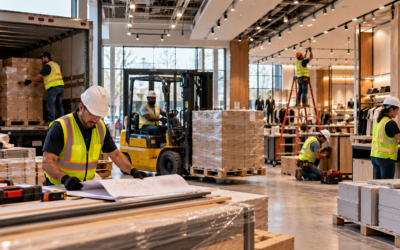
5. Coordinate Materials, Fixtures, and Procurement Early
Even the best design documentation cannot maintain consistency if locations receive the wrong materials, substitute products, or incompatible fixtures.
Material and fixture coordination is especially important in nationwide retail refreshes because multiple locations may require the same products within a compressed delivery window.
A centralized procurement strategy should establish:
-
Approved manufacturers, products, and finish selections
-
Product specifications and submittal approval procedures
-
Material quantities and location-level requirements
-
Procurement schedules aligned with construction sequencing
-
Delivery dates and receiving procedures
-
Storage and handling requirements
-
Inventory tracking and distribution plans
-
Approval procedures for substitutions
-
Replacement strategies for damaged or defective materials
Material substitutions deserve particular attention. A product that appears similar in a catalog may differ in color, sheen, texture, dimensions, or performance once installed.
No substitution affecting the approved brand appearance should proceed without the appropriate review and approval.
The team should also consider lead times and product availability early in planning. If an approved material is unavailable, a suitable alternative should be evaluated before the affected location reaches the installation stage.
Why this matters: Standardized procurement reduces unnecessary variation, while early coordination helps prevent material shortages from forcing rushed decisions in the field.
6. Implement Centralized Project Management Across All Locations
A nationwide retail refresh involves many moving parts: construction schedules, materials, subcontractors, site access, inspections, store operations, and corporate approvals.
Managing each location independently can create fragmented communication and inconsistent execution.
Centralized program management establishes common processes for coordinating the entire portfolio.
An effective management structure should include:
-
A designated program management lead
-
Defined roles and responsibilities
-
Standardized project schedules and milestone definitions
-
Centralized documentation and change control
-
Regular progress reporting
-
Clear issue escalation procedures
-
Consistent communication with corporate and field teams
-
Portfolio-level tracking of cost, schedule, quality, and completion
This structure helps ensure that a problem identified at one location can be evaluated for its potential impact on other stores.
For example, if an installation detail repeatedly causes delays, the program team can clarify the specification, communicate the solution, and update the execution process before the same problem occurs at additional locations.
Centralized oversight also provides a clearer view of overall program health. Rather than relying on separate updates from individual contractors, the retailer can evaluate progress against common reporting standards.
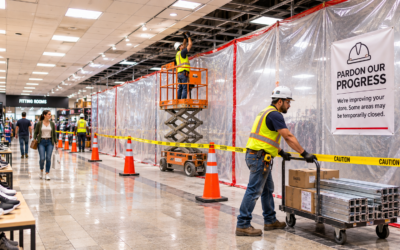
7. Maintain Brand Standards During Construction in Live Stores
Many retail refreshes take place while stores remain open, creating additional challenges for both construction teams and store operations.
Work areas must be managed carefully to protect customers, employees, merchandise, and the shopping experience.
At the same time, temporary construction conditions should not unnecessarily damage existing brand elements or create inconsistent presentation between locations.
A live-store execution plan should address:
-
Construction phasing and work-zone boundaries
-
Customer and employee circulation
-
Dust, noise, and debris control
-
Protection of merchandise, fixtures, and existing finishes
-
Temporary signage and customer wayfinding
-
Night work or other approved off-hours activities
-
Daily cleanup and site restoration
-
Coordination with store management
-
Safe access to required exits and building systems
Temporary conditions also deserve attention from a brand perspective. Improvised signage, exposed materials, poorly maintained barriers, and inconsistent temporary layouts can undermine the customer experience before the permanent refresh is complete.
Where stores must remain operational, the contractor and retailer should agree on approved temporary arrangements and clearly communicate expectations to field teams.
A consistent live-store plan allows construction to proceed while protecting both safety and the brand’s presentation.
8. Conduct Standardized Quality Inspections and Final Walkthroughs
Brand consistency cannot be assumed simply because construction is complete.
Every location should be evaluated against defined quality and acceptance criteria before it is considered finished.
A standardized inspection process makes those expectations measurable and helps identify deviations while corrections are still manageable.
A retail refresh quality checklist should cover:
Visual consistency
-
Colors, finishes, and materials match approved specifications.
-
Signage and branded graphics are correctly positioned.
-
Fixtures are aligned with approved layouts.
-
Millwork, trim, and transitions are finished properly.
-
Lighting produces the intended presentation.
Construction quality
-
Surfaces are clean and free of visible defects.
-
Installed materials are secure and properly finished.
-
Doors, hardware, fixtures, and equipment operate as intended.
-
Work is complete according to the approved scope.
-
Deficiencies and damaged materials are documented.
Operational readiness
-
Work areas are clean and ready for normal use.
-
Required inspections and approvals have been addressed.
-
Outstanding items have assigned owners and completion dates.
-
Required closeout documentation has been collected.
-
Store personnel know about any remaining work or restrictions.
Use consistent inspection forms and photographic documentation across locations. Where appropriate, require corrective work to be verified before a site receives final acceptance.
The result is a documented quality process that protects brand standards instead of relying solely on individual judgment.
The Retail Refresh Quality Control Checklist
The following checklist brings the eight steps together into a practical control framework for multi-location retail refresh programs.
Program readiness checklist
Planning: Approved brand standards, drawings, and finish schedules are available.
Site assessment: Existing conditions are documented, and location-specific risks are identified.
Scope and approvals: Base scope, site-specific adjustments, and required approvals are confirmed.
Pilot validation: New or materially revised standards are validated before broad rollout.
Procurement: Materials, fixtures, quantities, and delivery dates are confirmed.
Quality control: Inspections use consistent criteria, and deficiencies are documented.
Closeout: Punch list items, required records, and final acceptance are completed.
This checklist can be adapted into a project management template, field inspection form, or portfolio-wide reporting tool. Its greatest value comes from using the same criteria consistently across all participating locations.
Common Mistakes That Undermine Brand Consistency During Retail Refreshes
Even well-planned refresh programs can experience inconsistencies when important controls are missing.
Understanding the most common mistakes helps retailers address them before they affect multiple locations.
Treating brand guidelines as design references instead of construction requirements
A visual presentation may show what a store should look like without fully explaining how to achieve that result.
Without dimensions, material specifications, installation details, and acceptance criteria, field teams may interpret the same design differently.
How to avoid it: Translate brand guidelines into construction-ready documents that clearly define the approved result and how it will be evaluated.
Skipping site assessments to save time
Using a standard scope without checking existing conditions can create problems when materials, fixtures, utilities, or structural conditions differ from expectations.
How to avoid it: Assess locations before finalizing scopes, and document any required deviations from the standard plan.
Allowing unapproved material substitutions
Last-minute substitutions can introduce visible differences in color, texture, finish, or product dimensions.
How to avoid it: Establish a formal substitution approval process and communicate approved alternatives before installation begins.
Managing each location as an independent project
When regional teams use different reporting formats, documentation standards, and quality expectations, the retailer loses visibility into overall program performance.
How to avoid it: Use centralized program management, standardized reporting, and a common set of quality criteria across the entire portfolio.
Compressing schedules at the expense of quality
Aggressive deadlines can encourage teams to rush installation, skip intermediate inspections, or defer corrective work until the end.
How to avoid it: Build quality checkpoints into the schedule and make inspection and acceptance requirements part of the execution plan.
Failing to communicate changes to field teams
An updated drawing or revised finish specification has little value if the affected teams continue using the previous version.
How to avoid it: Maintain controlled document distribution, communicate revisions directly, and confirm that superseded instructions are no longer being used.
Closing projects without verifying final quality
A store may be substantially complete while still containing visible defects, incorrect finishes, incomplete signage, or unresolved punch list items.
How to avoid it: Conduct documented final walkthroughs against the same acceptance criteria at every location.
What to Look for in a General Contractor for a Nationwide Retail Refresh Program
Choosing the right general contractor is an important part of maintaining brand consistency across a multi-location refresh.
Retailers should evaluate more than a contractor’s ability to complete individual projects. They should assess whether the contractor can coordinate the entire program while maintaining the same standards across different markets.
Nationwide execution capability
Look for a contractor with the geographic reach, trade partner relationships, and operational structure to support the locations included in the program.
Ask how the contractor manages regional differences without allowing quality standards to vary.
Experience in retail construction
Retail environments introduce specific requirements involving customer access, store operations, merchandise protection, fixtures, finishes, and opening schedules.
A contractor familiar with retail construction is better positioned to anticipate these coordination needs and develop appropriate execution plans.
Centralized project and program management
Ask how the contractor tracks schedules, budgets, site progress, change orders, and quality issues across multiple locations.
The goal is to establish a clear reporting structure and a reliable point of accountability.
Standardized quality assurance
A contractor should be able to explain how work is inspected, how deficiencies are documented, who approves corrective actions, and how completed work is verified.
Look for a process that can be applied consistently across all participating locations.
Ability to coordinate multiple trades
Retail refreshes may require demolition, carpentry, painting, flooring, millwork, signage, lighting, electrical work, and technology coordination.
The general contractor should be able to coordinate the applicable trades so that one workstream does not compromise another or delay the overall program.
Clear communication and closeout procedures
Ask what reporting the retailer will receive, how issues are escalated, and what documentation is provided at completion.
A reliable process helps the retailer maintain visibility from initial planning through final acceptance.
These capabilities are especially important when a retailer needs one general contracting partner to support recurring refreshes, remodels, and broader multi-site rollout programs.
How Prime Retail Services Supports Consistent Retail Refresh Execution
Maintaining brand consistency across multiple locations requires a construction partner that understands the relationship between standardized execution, site-specific conditions, and centralized program oversight.
Prime Retail Services is a nationwide commercial general contractor supporting retail construction, remodels and renovations, build-outs and refreshes, multi-site rollout programs, and FF&E installation programs.
For retail refresh initiatives, these capabilities are relevant to the practical work required to translate approved brand standards into completed physical environments.
A coordinated execution approach can help retailers:
-
Align construction scopes with approved design and brand requirements.
-
Coordinate applicable trades and installation activities across locations.
-
Manage schedules, site conditions, and project documentation.
-
Identify and communicate issues that could affect quality or completion.
-
Maintain consistent expectations for project closeout.
For retailers managing refreshes across multiple markets, the value of a general contractor extends beyond the construction performed at an individual store. It also lies in the ability to coordinate the broader program and maintain a consistent process across locations.
Prime Retail Services also works alongside its affiliated divisions, Prime-Net and Prime Power Solutions, which provide specialized low-voltage and network infrastructure, and electrical services, respectively. When included in a project’s scope, coordinating these capabilities with the broader construction program can help align physical refresh work with the infrastructure requirements of the store.
The specific responsibilities and deliverables should always be defined by the approved project scope, site requirements, and applicable agreements.
Frequently Asked Questions
What is a retail refresh program?
A retail refresh program is a coordinated initiative to update existing store environments through improvements such as new finishes, fixtures, signage, lighting, layouts, and branded elements. It may involve a single location or a portfolio-wide program spanning multiple markets.
Unlike a full store rebuild, a refresh often focuses on targeted improvements while preserving portions of the existing space and infrastructure.
How do retailers maintain brand consistency across multiple store locations?
Retailers maintain brand consistency by establishing approved design standards, conducting site assessments, standardizing construction scopes, controlling material substitutions, coordinating work through centralized program management, and inspecting completed locations against consistent quality criteria.
These controls help ensure that every store reflects the intended brand identity despite differences in existing conditions and local construction requirements.
Why is a nationwide general contractor important for a retail refresh program?
A nationwide general contractor can coordinate construction across multiple markets through centralized project management, standardized processes, trade coordination, schedule tracking, and consistent quality controls.
This approach can reduce fragmentation and give retailers a clearer view of progress, risks, and outstanding work across the entire program.
How can retailers prevent construction variations between locations?
Retailers can prevent unnecessary variations by providing construction-ready specifications, maintaining controlled drawing revisions, establishing approved material lists, documenting site-specific adjustments, and using standardized inspection checklists.
Regular communication between corporate teams, project managers, and field personnel is also essential.
Should retailers complete a pilot store before launching a nationwide refresh?
A pilot store is valuable when a refresh introduces a new prototype, unfamiliar materials, revised installation details, or significant changes to the construction process.
It allows the team to validate assumptions, identify potential problems, and refine the execution plan before committing to a larger rollout. Established programs with proven standards may not require a full pilot for every refresh cycle.
How can brand consistency be measured during a retail refresh?
Retailers can measure consistency through brand standards compliance rates, first-pass inspection results, punch list trends, rework rates, material substitution frequency, and documented closeout completion.
These metrics help identify recurring quality issues and determine whether corrective actions are improving execution across locations.
Can retailers maintain brand consistency when stores remain open during construction?
Yes. With appropriate planning, retailers can maintain brand standards while stores remain operational. Construction phasing, merchandise protection, controlled work zones, off-hours scheduling, and daily cleanup help preserve safety and the customer experience.
Temporary arrangements should also be coordinated so they remain consistent with the retailer’s operational and presentation requirements.
What should a retail refresh construction checklist include?
A retail refresh checklist should cover brand standards, site assessments, approved scopes, material procurement, construction phasing, quality inspections, punch list resolution, and final closeout documentation.
For multi-location programs, the same core checklist should be used across locations, with additional requirements added for site-specific conditions and applicable regulations.
How early should a general contractor be involved in a retail refresh program?
Ideally, the general contractor should be involved during early planning, before scopes, budgets, and schedules are finalized. Early coordination can help identify existing-condition risks, clarify construction requirements, assess material lead times, and develop realistic execution plans.
This is particularly valuable when the refresh involves multiple locations with different building conditions or operational constraints.
Final Thoughts
Maintaining brand consistency during retail refresh programs requires more than a well-designed store prototype. It requires a repeatable execution process that connects brand standards, construction planning, procurement, field coordination, and quality assurance across every location.
For multi-location retailers, the challenge is to preserve a recognizable customer experience while adapting construction to the realities of individual stores. Clear specifications, documented site conditions, centralized program management, and consistent inspections provide the foundation for achieving that balance.
A nationwide general contractor like Prime Retail Services can help retailers coordinate refreshes, remodels, and multi-site construction programs with an emphasis on consistent execution, project accountability, and brand standards.
If your organization is planning a retail refresh, a brand-wide renovation, or a nationwide rollout, contact info@primeretailservices.com to discuss your construction requirements and how we can support your next program.