Retail construction does not always require a store to close its doors.
Many retailers choose to complete renovations, equipment upgrades, fixture replacements, and other construction activities while continuing normal business operations. This approach can help maintain revenue, reduce operational disruption, and allow improvements to be completed without a full store closure.
However, keeping a retail location open during construction introduces additional safety responsibilities.
Construction crews must work around customers, employees, merchandise, deliveries, and daily store activities. At the same time, retailers must maintain safe access, clear walkways, and a controlled environment throughout the project.
A construction area that is safe for trained workers may still present hazards to customers who are unfamiliar with the work being performed.
For this reason, open-store construction requires more than standard jobsite safety procedures. It demands a coordinated plan that addresses construction hazards and the unique risks associated with an occupied commercial environment.
The objective is to complete the required work while protecting everyone who enters, works in, or operates the facility.
Why Safety Planning Is Different in Open-Store Construction
Traditional construction sites typically have controlled access and clearly defined work areas. Retail environments are different because customers and employees continue using the facility while construction is underway.
This creates overlapping responsibilities.
Construction teams must follow applicable jobsite safety requirements while retailers must maintain safe conditions for customers and employees.
Common risks include:
- Customers entering restricted construction areas
- Trip hazards from tools, cords, and construction materials
- Falling objects and overhead work
- Dust, debris, and airborne particles
- Noise and vibration
- Exposed electrical components
- Temporary lighting or power interruptions
- Blocked aisles and emergency exits
- Equipment and material movement
- Slippery floors and uneven walking surfaces
- Delivery and loading-area conflicts
These risks can change throughout the day as construction activities move between work areas.
A safety plan should therefore be developed before mobilization and reviewed regularly as the project progresses.
For additional context on construction within operating retail environments, see Retail Construction in Open Stores.
1. Establish Clearly Defined Construction Zones
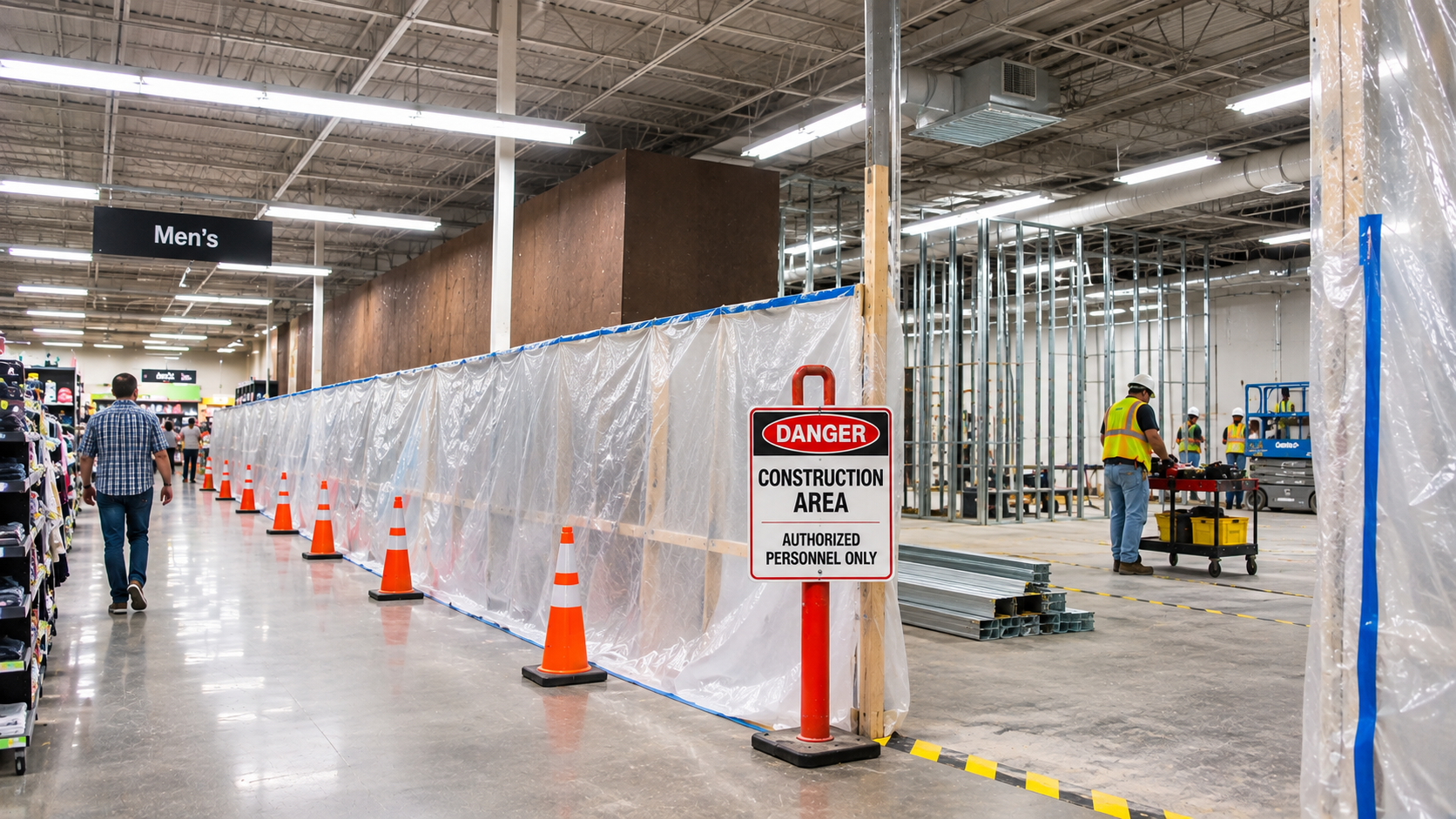
One of the most important safety measures in an open-store project is physically separating construction activities from customer and employee areas.
A clearly defined construction zone helps prevent unauthorized access and reduces the likelihood of accidental exposure to construction hazards.
Depending on the scope, separation measures may include:
- Temporary solid barriers
- Construction fencing
- Approved temporary partitions
- Safety barricades
- Controlled entry points
- Warning signs
- Restricted-access doors
- Floor markings
- Overhead protection where required
Barriers should be appropriate for the hazards involved. Warning tape or a simple sign may not provide sufficient protection when the work involves demolition, overhead activities, exposed utilities, or powered equipment.
The project team should also verify that temporary barriers are stable, properly installed, and maintained throughout the work period.
Construction boundaries must be adjusted when work areas change.
A barrier that protects one section of the store may become ineffective if crews begin working in an adjacent aisle or move materials through an active customer area.
2. Maintain Safe Customer and Employee Access
Retailers must maintain safe routes for customers and employees throughout construction.
Temporary construction activities should not create unexpected obstacles or force people into unsafe areas.
Before work begins, the project team should identify:
- Customer entrances and exits
- Accessible routes
- Employee access points
- Emergency exits
- Fire extinguisher locations
- Fire alarm and life safety equipment
- Restrooms and customer service areas
- Delivery and receiving routes
- Designated construction access
Temporary walkways should remain clear, properly marked, and adequately illuminated.
If an aisle or entrance must be temporarily closed, the retailer and construction team should coordinate an alternate route.
Accessibility must also be considered. Temporary changes should not create barriers that prevent customers or employees with disabilities from safely navigating the facility.
Emergency exits and required egress paths must remain available in accordance with applicable requirements. If construction affects an approved exit route, the appropriate safety and fire protection procedures must be coordinated before work proceeds.
For projects involving significant changes to store layouts or access routes, early coordination is essential.
3. Control Dust, Debris, and Airborne Particles
Dust and debris are common concerns during retail renovations, particularly when work involves demolition, cutting, drilling, sanding, or ceiling modifications.
In an operating store, these activities can affect customers, employees, merchandise, and sensitive equipment.
The project team should evaluate the type of work being performed and establish appropriate containment measures.
Possible controls include:
- Sealed temporary enclosures
- Dust barriers and partitions
- Appropriate ventilation controls
- Local exhaust systems
- HEPA-filtered equipment where appropriate
- Dust collection during cutting and drilling
- Regular cleaning of work areas
- Proper debris containment
- Covered material transport
- Controlled disposal procedures
The specific controls should reflect the materials, work methods, and exposure risks involved.
Special attention is necessary when construction takes place near food preparation, grocery departments, pharmacies, healthcare-related spaces, or other environments with additional cleanliness requirements.
Construction debris should never be left where customers or employees can encounter it.
Daily housekeeping is an important part of maintaining a safe and professional retail environment.
4. Manage Overhead Work and Falling-Object Hazards
Retail construction frequently involves work above floor level.
Ceiling repairs, lighting replacement, electrical installation, HVAC modifications, signage installation, and overhead infrastructure work may require ladders or elevated work platforms.
These activities introduce risks that extend beyond the immediate work area.
Potential hazards include:
- Falling tools
- Dropped materials
- Unsecured ceiling components
- Dust and debris falling from overhead spaces
- Equipment movement
- Improper ladder use
- Unauthorized access beneath active work
Before overhead work begins, the team should establish an exclusion zone beneath the activity.
The area should be physically separated from customer and employee traffic, with suitable barriers and warning signs.
Tools and materials should be secured appropriately, and workers should use equipment designed for the specific task.
Where required, overhead work should be scheduled outside normal operating hours or performed in an area that can be fully isolated from the public.
The project team should also inspect the area after overhead work is completed to confirm that no loose materials, debris, or exposed hazards remain.
5. Maintain Electrical Safety During Construction
Electrical work presents significant risks in active retail environments.
Renovations may involve new circuits, lighting upgrades, equipment connections, panel modifications, and temporary power arrangements.
Customers and employees should never be exposed to energized components, open electrical enclosures, unsecured wiring, or temporary installations that create hazards.
Important precautions include:
- Restricting access to electrical work areas
- Keeping electrical panels accessible only to authorized personnel
- Protecting exposed conductors and equipment
- Using appropriate temporary power distribution
- Inspecting cords and electrical tools
- Protecting cables from foot traffic and damage
- Maintaining required clearances
- Coordinating shutdowns and utility interruptions
- Following applicable lockout/tagout procedures
- Using appropriately qualified electrical personnel
Extension cords and temporary cables should not be routed through public walkways without suitable protection and an approved arrangement.
Electrical work should be performed by qualified personnel in accordance with applicable codes, regulations, and project requirements.
For additional guidance, see:
6. Coordinate Material Handling and Equipment Movement
Construction materials and equipment must move through the facility without creating unnecessary risks for customers or employees.
This can be challenging when the store remains open and receiving areas, corridors, and service entrances are shared.
Potential hazards include:
- Moving carts and equipment
- Forklifts and powered industrial trucks
- Material deliveries
- Heavy or oversized fixtures
- Unsecured loads
- Blocked aisles
- Congested receiving areas
- Improper material storage
A material handling plan should identify approved delivery routes, staging locations, and movement schedules.
Whenever practical, deliveries should take place during designated receiving periods or outside peak customer hours.
Construction materials should be stored securely and kept out of public access areas.
Large fixtures, millwork, and equipment may require additional planning to confirm that they can be moved safely through entrances, corridors, and other restricted spaces.
Equipment operators should be qualified, and pedestrian traffic should be separated from equipment movement.
For projects involving extensive fixture packages, see Fixture and Millwork Installation Best Practices.
7. Control Noise, Vibration, and Disruptive Activities
Noise and vibration may not always create direct physical hazards, but they can affect customer comfort, employee communication, and normal store operations.
Certain construction activities may also create additional risks when performed near occupied areas.
Examples include:
- Concrete drilling
- Saw cutting
- Demolition
- Core drilling
- Ceiling removal
- Heavy equipment operation
- Material handling
- Mechanical installation
The project team should identify high-impact activities during planning and coordinate when and where they will occur.
Possible measures include:
- Scheduling noisy work outside peak business hours
- Isolating construction areas
- Using suitable equipment and methods
- Communicating planned disruptions
- Monitoring vibration where required
- Protecting nearby merchandise and equipment
- Coordinating temporary area closures
If an activity creates unacceptable conditions for customers or employees, the team should evaluate whether it can be rescheduled or performed during a controlled closure.
8. Maintain Fire and Life Safety Protection
Fire and life safety requirements deserve particular attention when construction occurs in an occupied facility.
Construction activities may temporarily affect fire protection systems, alarms, exit access, or other life safety components.
These systems must not be compromised without the required coordination and authorization.
Important considerations include:
- Maintaining access to fire extinguishers
- Keeping required exit routes clear
- Protecting fire alarm devices
- Coordinating sprinkler system work
- Managing temporary fire protection arrangements
- Controlling hot work activities
- Maintaining appropriate fire watch procedures when required
- Removing combustible debris
- Securing flammable materials
- Communicating emergency procedures
Hot work, such as welding, cutting, or grinding, may require permits and additional precautions depending on the site and applicable requirements.
Any impairment of a fire protection or alarm system should follow the facility’s established impairment procedures and applicable requirements.
The construction team and retailer should coordinate with the appropriate facility representatives and authorities before any work affects these systems.
9. Use Proper Personal Protective Equipment and Worker Training
Construction crews must be prepared to work safely in an occupied commercial environment.
Personal protective equipment should be selected according to the hazards associated with each activity.
Depending on the scope, this may include:
- Hard hats
- Safety glasses
- High-visibility apparel
- Protective gloves
- Safety footwear
- Hearing protection
- Respiratory protection
- Fall protection equipment
PPE does not replace hazard elimination, engineering controls, or appropriate work procedures. It is one part of a broader safety program.
Workers should also understand the additional responsibilities associated with working around the public.
Training and site orientation should cover:
- Site-specific hazards
- Construction zone boundaries
- Customer and employee separation
- Emergency procedures
- Material handling requirements
- Housekeeping expectations
- Restricted areas
- Incident reporting
- Communication procedures
- Required PPE
Subcontractors and temporary personnel should receive the appropriate site orientation before beginning work.
10. Establish Daily Safety Inspections and Housekeeping Procedures
Open-store construction conditions can change quickly.
A work area that was safe at the beginning of a shift may become hazardous after material deliveries, demolition, equipment movement, or changes in construction activities.
Daily inspections help identify these changes before they affect customers or employees.
Inspections should consider:
- Condition of temporary barriers
- Construction zone access controls
- Customer and employee pathways
- Floor conditions
- Loose materials and debris
- Electrical cords and temporary power
- Equipment condition
- Overhead work areas
- Fire protection access
- Emergency exits
- Signage and warning devices
- Material storage
- Required PPE and worker practices
Housekeeping should take place throughout the workday, not only at the end of a shift.
Tools, debris, and materials should be removed or secured when they are not in use.
Before a construction area is reopened to customers or employees, the project team should verify that the area is clean, safe, and ready for normal access.
11. Coordinate Communication Between the Contractor and Store Management
Safety in an operating retail facility depends on clear communication between construction personnel and store management.
Both parties need to understand what work is taking place, where construction activities are occurring, and whether any conditions could affect store operations.
A communication plan should establish:
- Designated construction and store contacts
- Daily work schedules
- Planned utility interruptions
- Delivery and equipment movement windows
- Temporary access restrictions
- Changes to construction boundaries
- Emergency contact procedures
- Incident reporting responsibilities
- Required approvals
- End-of-shift turnover procedures
Store management should be informed before activities affect customer access, employee routes, utilities, or store operations.
Likewise, construction crews should be notified of store events, delivery schedules, unusual customer traffic, and operational conditions that may affect the work.
Regular coordination meetings can help prevent misunderstandings and identify potential safety concerns before they become problems.
12. Determine When Work Should Be Performed After Hours
Not every construction activity is suitable for execution during normal business hours.
Some work may create excessive noise, dust, vibration, access restrictions, or safety risks that cannot be adequately controlled while customers are present.
In these situations, after-hours construction may be the more appropriate approach.
Activities that may require non-operating hours include:
- Extensive demolition
- Overhead installations
- Electrical shutdowns
- Major equipment movement
- Flooring removal and installation
- Work affecting primary customer pathways
- Activities requiring broad area isolation
The decision should be based on the actual hazards and operational requirements, not simply convenience.
After-hours work still requires proper supervision, safety controls, and coordination with store management.
For additional guidance, see Best Practices for After-Hours Retail Construction.
Common Safety Mistakes in Open-Store Construction
Even well-planned projects can encounter safety problems when construction teams overlook the additional responsibilities of working in occupied retail environments.
Relying on Warning Signs Instead of Physical Barriers
Signs alone may not prevent customers from entering hazardous areas.
Better approach: Use barriers appropriate to the work and restrict access to active construction zones.
Allowing Materials to Obstruct Walkways
Tools, extension cords, debris, and deliveries can create trip hazards.
Better approach: Maintain designated staging areas and inspect customer pathways throughout the day.
Performing Overhead Work Above Public Areas
Tools, materials, or debris may fall from elevated work areas.
Better approach: Establish exclusion zones and schedule overhead work when the affected area can be safely isolated.
Ignoring Dust Containment
Dust can spread beyond the construction zone and affect merchandise, employees, customers, and equipment.
Better approach: Use suitable containment, collection, ventilation, and housekeeping procedures.
Overlooking Emergency Access
Temporary partitions and material staging can unintentionally restrict emergency routes.
Better approach: Verify required exit access and emergency equipment locations before work begins and throughout construction.
Failing to Coordinate With Store Management
Construction activities may conflict with deliveries, customer traffic, or operational requirements.
Better approach: Maintain regular communication and notify store management of planned disruptions and changing conditions.
Treating End-of-Day Cleanup as Optional
Loose debris, tools, or unsecured materials can create hazards after construction crews leave.
Better approach: Establish a documented end-of-shift inspection and turnover process.
How to Measure Safety Performance During Open-Store Construction
Safety performance should be evaluated throughout the project rather than only after an incident occurs.
A combination of inspections, observations, reporting, and corrective action tracking helps identify risks and improve site conditions.
| Safety Indicator | What It Measures |
| Daily safety inspections | Completion of scheduled site safety reviews |
| Hazard observations | Potentially unsafe conditions identified during work |
| Corrective action closure | Timely resolution of identified hazards |
| Barrier compliance | Condition and effectiveness of construction zone separation |
| Housekeeping inspections | Cleanliness and organization of work areas |
| Access route inspections | Availability of safe customer and employee pathways |
| PPE compliance | Proper use of required protective equipment |
| Safety orientation completion | Completion of required worker onboarding |
| Incident and near-miss reporting | Identification and documentation of safety events |
| Emergency access verification | Continued access to required exits and safety equipment |
Tracking these indicators helps project teams identify recurring problems and improve safety procedures across locations.
What to Look for in a General Contractor for Open-Store Construction
Retailers should evaluate a general contractor’s ability to manage construction safely within an operating environment.
Experience with retail construction is important, but the contractor should also demonstrate an understanding of customer protection, employee access, and daily operational coordination.
Important qualifications include:
Occupied-site experience: Has the contractor completed construction projects while retail facilities remained open?
Site safety planning: Can the team develop and maintain appropriate barriers, access controls, and hazard prevention measures?
Dust and debris management: Does the contractor have procedures for containment, cleaning, and material disposal?
Trade coordination: Can multiple subcontractors work within defined areas without creating conflicts or exposing the public to hazards?
After-hours capabilities: Can the contractor coordinate work during approved non-operating hours when necessary?
Communication: Does the team maintain clear communication with store management and other project stakeholders?
Field supervision: Are qualified personnel responsible for monitoring construction activities and addressing safety concerns?
Quality and closeout: Does the contractor verify that completed areas are safe before returning them to normal use?
For more information, see Benefits of Working With One Nationwide General Contractor.
Managing Safety Across Multi-Location Retail Programs
Safety planning becomes more challenging when construction is taking place across multiple stores.
Each location may have different layouts, customer traffic patterns, access conditions, building systems, and operational requirements.
A nationwide program should establish consistent safety expectations while allowing site-specific controls.
Important considerations include:
- Standardized site safety procedures
- Location-specific hazard assessments
- Consistent construction barrier requirements
- Approved worker orientation procedures
- Standardized inspection checklists
- Clear incident reporting processes
- Regional field supervision
- Centralized safety documentation
- Consistent corrective action tracking
- Regular program-level safety reviews
Centralized oversight helps project teams identify recurring safety concerns and communicate lessons learned across locations.
However, each site must still be evaluated individually. A safety plan suitable for one store may not be appropriate for another.
For additional guidance, see:
- Successful Multi-Site Rollout
- Nationwide Construction Program Management
- How Centralized Oversight Improves Consistency
How Prime Retail Services Supports Construction in Operating Retail Environments
Prime Retail Services is a nationwide commercial general contractor supporting construction, renovation, and multi-location programs across retail and other commercial environments.
Construction within an operating facility requires careful coordination between project requirements, field activities, safety controls, and store operations.
Our approach emphasizes disciplined planning, coordinated trade execution, and project oversight throughout the construction process.
Our capabilities include:
- Remodels and Renovations: Coordinated construction activities within existing commercial facilities.
- Build-Outs and Store Refreshes: Execution of commercial improvements and interior modifications.
- Special Project Rollouts: Coordinated execution for time-sensitive construction requirements.
- Multi-Site FF&E Programs: Management of fixture, furniture, and equipment installations across multiple locations.
- Electrical Coordination: Additional project capabilities through Prime Power Solutions.
- Technology Deployment: Technology installation and infrastructure support through Prime-Net.
Through our proprietary 3P Process, Perfect, Project, Process, we emphasize execution quality, project coordination, and repeatable procedures that support consistent project delivery.
With general contracting licenses in 49 states, excluding Hawaii, Prime Retail Services supports commercial construction requirements across a broad geographic footprint.
Our focus is to help clients coordinate construction activities, manage project requirements, and maintain visibility throughout execution.
Frequently Asked Questions
What is open-store construction?
Open-store construction refers to renovation, installation, or improvement work performed while a retail facility remains open to customers and employees.
What are the biggest safety risks during open-store construction?
Common risks include unauthorized access to construction areas, falling objects, trip hazards, dust exposure, electrical hazards, equipment movement, blocked walkways, and disruptions to emergency access.
How do contractors protect customers during construction?
Contractors use appropriate barriers, controlled access points, warning signs, designated walkways, dust containment, housekeeping procedures, and coordinated work schedules to separate construction activities from public areas.
Should retail construction areas be physically separated?
Yes. Construction zones should be separated using barriers appropriate to the hazards involved. Warning signs alone may not provide adequate protection.
Can construction take place while customers are shopping?
Yes, provided the work can be performed safely with appropriate controls. Activities that cannot be adequately separated from customers may need to be rescheduled or performed after hours.
How is dust controlled during retail renovations?
Depending on the work, controls may include sealed enclosures, dust barriers, local exhaust, dust collection equipment, appropriate filtration, and regular cleaning.
How should contractors manage overhead construction work?
The team should establish exclusion zones, secure tools and materials, use appropriate elevated work equipment, and prevent customers and employees from entering areas beneath active overhead work.
What happens if construction affects emergency exits?
Required exit access must be maintained in accordance with applicable requirements. Any necessary changes must be coordinated with the appropriate facility representatives and authorities before implementation.
Who is responsible for safety during open-store construction?
Safety responsibilities are shared among the parties involved. The general contractor, subcontractors, retailer, and facility representatives must coordinate their respective responsibilities according to applicable laws, project agreements, and site requirements.
Why are daily safety inspections important?
Conditions can change as work progresses. Daily inspections help identify hazards involving barriers, walkways, materials, equipment, housekeeping, and emergency access before they affect people in the facility.
Final Thoughts
Open-store construction requires a higher level of coordination because construction activities take place alongside normal business operations.
Protecting customers and employees depends on more than posting warning signs or restricting access to a work area. It requires a comprehensive approach to hazard prevention, physical separation, housekeeping, trade coordination, communication, and daily supervision.
When these measures are integrated into the construction plan, retailers can make progress on facility improvements while maintaining a safer environment for everyone involved.
The objective is to complete the work without exposing customers, employees, or construction crews to unnecessary risks.
Planning a retail renovation while keeping your store open?
Contact Prime Retail Services at info@primeretailservices.com to discuss your next commercial construction project.